Keyword Research Process for B2B Content With Long Sales Cycles
Target keywords to each stakeholder's role and buying phase, not search volume alone.

B2B sales cycles now average 379 days, up 16% since 2021, and the average buying committee runs 10 to 13 people deep. That means keyword research built around search volume alone is solving the wrong problem. What matters is which keyword reaches the right stakeholder, at the right stage, in a deal that might not close until next winter. It's which keyword reaches the right stakeholder, at the right stage, in a deal that might not close until next winter.
Most keyword tools still reward broad, high-volume terms. That's a consumer-shopping heuristic wearing a B2B costume. A CFO researching payback periods and an IT director checking SOC 2 compliance are not the same buyer typing "best running shoes," and treating their searches the same way is why so much B2B content sits at position 8 with zero conversions. The channel itself isn't broken, though. Organic search converts at a far higher rate than outbound, with leads from organic roughly 14.6% compared to 1.7% for outbound. The methodology just needs a rebuild.
How the buying journey unfolds, and what each phase looks like in search
Buyers do most of the work before anyone from sales gets a phone call. Gartner puts independent research at 74% of the total buying journey, spread across an average of 13 pieces of content. 6sense's research found buyers are already 61% through their decision by the time they talk to a vendor, which means most of the elimination round has already happened by the time a rep says hello.
TrustRadius data backs this up from a different angle: the average shortlist has just 2 to 3 products on it, and 71% of buyers end up purchasing whichever one was their first choice. Shortlist formation is the whole game. And it happens quietly, in search, long before a demo gets booked.
That journey breaks into three phases, and each one sounds completely different in a search bar.
Phase 1, problem diagnosis, includes queries like "what is X" or "how does Y work." The buyer doesn't know what category of tool solves their problem yet, let alone which vendor.
Phase 2, solution evaluation, includes "X vs Y," "best tool for [industry]." This is active shortlisting. The buyer knows the category and is now comparing named options.
Phase 3, justification and procurement, includes pricing pages, compliance docs, integration specs, ROI math. This is the buyer building an internal case they can defend in a budget meeting.
One article cannot serve all three. A pillar page trying to be everything to everyone usually ends up being nothing to anyone. And most of Phase 1 and Phase 2 activity happens in what's called the dark funnel, where there's no form fill, no email capture, no CRM record. The only trace it leaves is whether the content got found at all.
Building stakeholder search maps before opening a keyword tool
Opening Ahrefs or Semrush before mapping stakeholders is like packing for a trip before checking the weather. Every role on a buying committee searches differently, and skipping this step usually means building a keyword list that serves one buyer while quietly ignoring the other five.
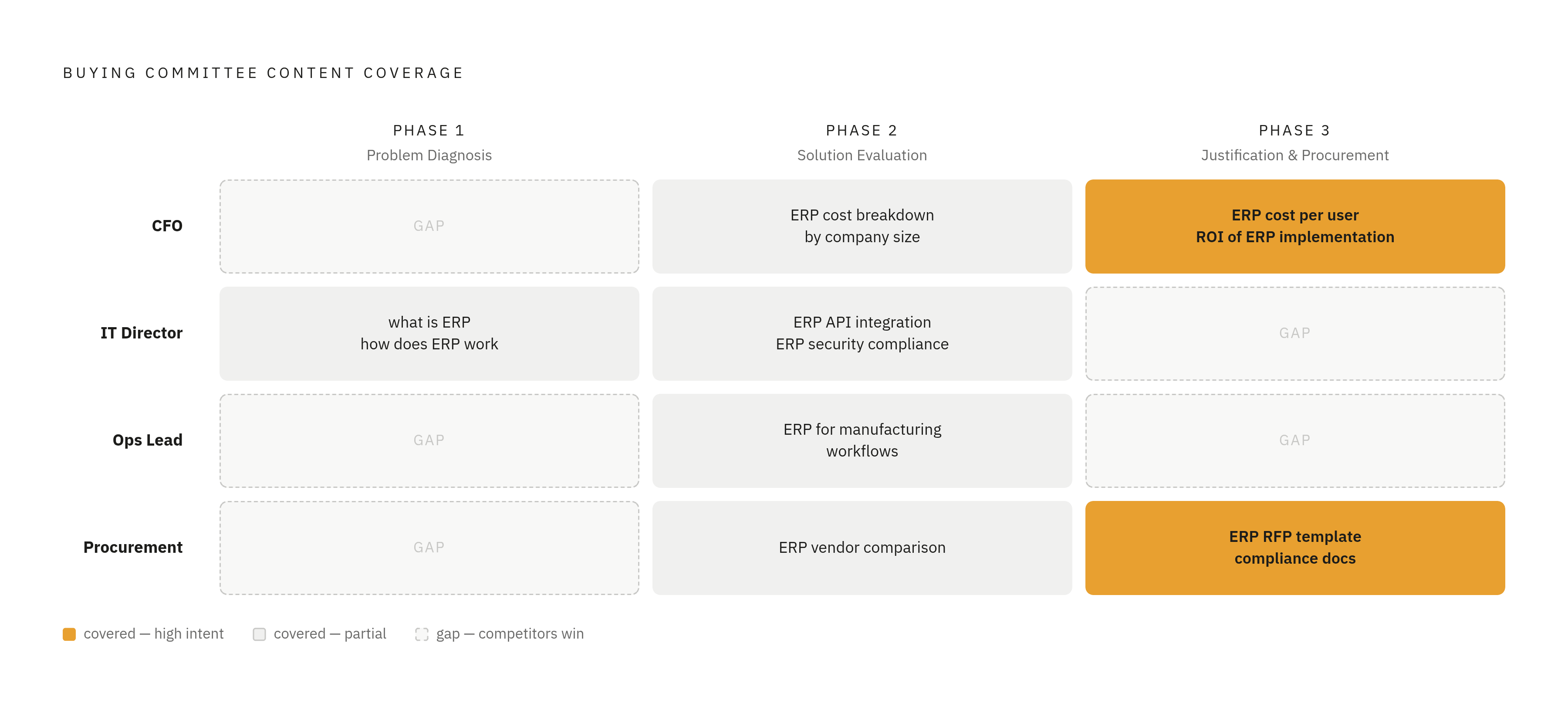
Take an ERP purchase as a working example. A CFO searches around cost and payback: "ERP software cost per user," "ROI of ERP implementation." An IT director searches around integration and security: "ERP API integration," "ERP security compliance." The ops lead who'll actually use the thing searches for workflow fit: "ERP for manufacturing workflows." And procurement searches around process: "ERP vendor comparison," "ERP RFP template."
Four roles, four completely different vocabularies, four different anxieties. None of them are searching the same words for the same reason.
The raw material for this map doesn't come from a keyword tool at all. It comes from sales call recordings, support tickets, actual customer interviews, and whatever's buried in CRM notes. The tools come in later, to validate and expand what the sales team already hears every week.
The useful output here is a simple grid: stakeholder roles down the side, buying-journey phases across the top, and a rough guess at what each role searches at each phase filling in the cells. Empty cells matter as much as full ones. They show you exactly where a role and a phase have zero content coverage right now, which is usually where competitors are quietly winning.
Research from Emblaze (2024, via Hey Sid) found a 54.5% average misalignment between how sellers describe the core problem and how buyers describe it. Closing that gap has been linked to meaningful improvements in win rates. That finding is about sales conversations, not keywords directly, but the lesson travels well. If the sales team and the buyer aren't even using the same words for the problem, no keyword list built on the sales team's language alone is going to reach the buyer.
Running the keyword tool research: generating, filtering, and validating candidates by intent
With the stakeholder map done, the tools finally earn their subscription fee. Seed topics come straight from that map. Google Search Console adds another layer: queries pulling meaningful impressions with close to zero clicks are often fast wins available, since they mean the page is already showing up, just not convincing anyone to click. Competitor gap analysis rounds out the input list.
From there, Semrush and Ahrefs handle volume and difficulty. AnswerThePublic and AlsoAsked list question-format queries in their results, which double as a window into how people actually phrase their confusion (AnswerThePublic also picks up query patterns from AI models, which matters more by the month). Search Console shows what's already ranking but under-optimized.
A five-stage process keeps this from turning into an unfocused scroll through spreadsheets:
- Define topic areas from what the business actually solves and what sales conversations actually cover, not from what happens to rank well elsewhere.
- Generate keyword candidates across all the source types above.
- Check SERP features for each cluster. Is an AI Overview showing up? What content format currently ranks? This decides format, not just word choice.
- Score candidates by business impact, meaning intent match, specificity, and conversion potential, not raw search volume.
- Map every surviving keyword to a cell in the stakeholder-stage matrix. If it doesn't fit a cell, it waits on the bench.
Intent classification deserves more nuance than the standard four-bucket model most SEO courses teach (informational, navigational, commercial, transactional). Google's own quality rater guidelines break things down further, with categories like Know, Do, Website, and Visit-in-Person, and each one lines up differently against the B2B buying phases above.
Long-tail queries make up 91.8% of all searches and, according to available research, convert at 2.5 times the rate of short-tail terms. In B2B, that's not a statistical footnote, that's where the actual qualified buyers are hiding. And a fair number of the best B2B keywords will show zero volume in every tool checked. Something like "HubSpot onboarding agency London" might return a flat zero in Semrush. That's a signal the buyer typing it is three keystrokes from filling out a contact form, not a signal to skip it. That's a signal the buyer typing it is three keystrokes from filling out a contact form.
Categorizing keywords by intent type: the four families that matter in long-cycle B2B
Four keyword families do most of the heavy lifting in long-cycle B2B, and each one calls for a different content shape.
Comparison keywords include "Vendor X vs Vendor Y," "Vendor X alternatives." Mid-funnel, active evaluation, a clear signal the buyer is shortlisting right now. These need proof and honest differentiation, not a sales pitch dressed up as an article.
Best-X-for-Y keywords include "Best CRM for manufacturing," "best project management tool for professional services." Also mid-funnel, but this is category filtering by fit. Generic content loses here. Industry specificity wins.
Integration and technical keywords include "Vendor X integration with Salesforce," "SOC 2 compliant data governance platform." Usually late-funnel, usually an IT or procurement evaluator doing due diligence. Needs real technical depth, not marketing gloss.
Pricing and ROI keywords include "Enterprise ERP cost per user," "ROI of revenue operations software." Late-funnel, almost always a CFO or finance stakeholder building the internal business case. Needs transparent numbers, not a "contact us for pricing" dead end.
Informational keywords from Phase 1 (the "what is X" searches) deserve separate handling. They get heavy AI Overview exposure and declining click rates, but they still matter enormously for brand visibility during that dark-funnel research window (more on that shortly).
Each family points to a different format. Comparison keywords want comparison pages or case-study-led evaluations. Integration keywords want technical spec sheets and solution briefs. Pricing keywords want an actual pricing page or ROI calculator, not a lead-gen wall. As a rough rule, the more words in the query, the closer that buyer is to signing something. Weight the content calendar accordingly.
How case studies and customer proof unlock the highest-intent keyword categories
Case studies are the single content type most tied to buyer decisions, not a nice-to-have bolted onto the bottom of a resources page. They're the single content type most tied to buyer decisions: research found 80% of B2B buyers use them during research, and 42% find them valuable at both the middle and late stages. That's exactly where comparison and decision keywords live.
Industry-specific case studies have been found to convert substantially better than generic ones, roughly five times better in some analyses. The mechanism is simple: buyers are looking for proof that "a company like mine, with my exact problem, got this result." A generic feature page can't say that. A case study can.
This is also how comparison and best-X-for-Y keywords actually get won. A page titled "[Product] for manufacturing companies," backed by a real case study from an actual manufacturer, will out-rank a generic feature page targeting "best [category] for manufacturing" almost every time, because it answers the buyer's real question instead of a marketer's assumption about the question.
A few structural choices make case studies do their job better in search:
The headline should quantify the result, not describe the activity. "Product X helped Acme cut onboarding time by [specific number]" beats "How Acme uses Product X," because the number is exactly what appears in a search snippet.
The Challenge-Solution-Impact structure appears across the large majority of top-performing B2B SaaS case studies, and for good reason: it's scannable for an executive skimming top to bottom, but still detailed enough for a technical evaluator who reads every line. Direct customer quotes throughout add a layer of credibility that both human readers and AI models tend to weight heavily as trustworthy sourcing.
Distribution matters just as much as writing. A case study sitting alone on a resources page, with no internal links pointing to it, earns almost no ranking authority on its own. Linking to it from related blog posts and cluster pages is what lets it accumulate the authority it needs to actually rank.
On length, a focused, readable format hits the sweet spot: long enough to be credible, short enough that a busy VP actually finishes it. A one-page PDF version serves sales decks well. A short video cut, roughly two and a half to just over three minutes, is the range associated with maximum engagement.
Organizing keywords into topic clusters that build authority across the buying arc
Isolated articles are a losing bet against topic clusters. Content organized into clusters drives meaningfully more organic traffic and holds its rankings considerably longer than standalone posts do. That's the compounding case for structure over scattershot publishing.
A cluster for a long-cycle B2B topic usually breaks into three layers. A pillar page covers the category broadly and authoritatively (something like "Revenue Operations for Manufacturing Companies"), aimed at that top-of-funnel educational query. Cluster posts then branch off it, each one built around a single stakeholder's concern at a single stage: a finance-facing ROI piece, a technical-facing integration piece, a procurement-facing vendor comparison piece. Case studies get embedded throughout, linking to and from the pillar, since those are the assets that actually earn the comparison and decision-stage rankings.
The stakeholder-stage matrix built earlier becomes the literal content calendar here. Every filled-in cell is a cluster article waiting to be written. The pillar page sits on top, covering the matrix as a whole.
HubSpot's own experience is a caution. Reporting on the company's SEO strategy found traffic dropped sharply after a period of publishing high volumes of content unrelated to its core product areas. Topical depth and relevance beat sheer breadth. Filling out a cluster with tangential posts just to hit a publishing quota tends to backfire, because Google's own systems for judging topical authority reward depth on a subject over volume for its own sake. Fewer, more complete cluster articles outperform a pile of thin ones every time.
Adjusting keyword and content strategy for AI search and declining informational CTR
AI Overviews have changed what a top ranking is even worth. An Ahrefs study covering 300,000 keywords found a 58% drop in click-through rate for the top organic result whenever an AI Overview appeared above it. Other analyses have similarly found steep declines in organic CTR specifically on queries that triggered an AI Overview. Additional research adds more context: a large share of US searches now end in zero clicks, meaning fewer than half of all searches result in a click to the open web.
Informational keywords take the biggest hit here, which is a problem specifically for B2B, since Phase 1 educational searches (the "what is X" and "how does Y work" queries sitting at the top of the stakeholder map) are exactly the category most exposed. Somewhere between 30% and 60% of B2B buyers now use AI assistants during vendor research. A brand that never gets cited in an AI-generated answer is becoming functionally invisible during that early dark-funnel window, even if its website ranks fine on a traditional search results page.
A few adjustments help content earn those citations. Every major question a page addresses should have a direct answer, one to three sentences, placed clearly rather than buried three paragraphs down. AI models pull bounded, factual answers, not context clues. Question-format keywords surfaced by AnswerThePublic and AlsoAsked should be structured as actual H2s and H3s, since that's the exact format AI models tend to lift from. And existing pages that already rank for informational terms should be audited for this kind of direct-answer formatting specifically, not just for keyword density, which is largely a solved problem at this point.
The strategic rebalance follows from all this. Early-stage informational keywords still earn their spot in the content calendar, but for AI citation and dark-funnel brand visibility, not for click volume, since the clicks on those terms are shrinking regardless of how well the page ranks. Mid-funnel comparison keywords and late-stage decision keywords are less exposed to AI Overview cannibalization and carry far higher click intent. Weight the calendar toward those accordingly. ChatGPT alone reports around 800 million weekly users, and Perplexity carries growing query volume of its own. Both represent real citation opportunities, and the same structured, fact-forward content that earns a spot in a Google AI Overview tends to perform well on those platforms too.
Deploying keywords through a sales-aligned content calendar, not a publishing schedule
None of this research generates a dollar of revenue until it reaches the right buyer at the right stage, on a timeline that actually matches how long the deal takes to close.
That means the content calendar can't run on a simple cadence, two posts a week, one case study a month, whatever looks tidy on a spreadsheet. It has to run on the stakeholder-stage matrix built back at the start of the process. Each empty cell in that matrix is a commitment: a finance-facing ROI piece that doesn't exist yet, a technical integration page nobody's written, a procurement comparison guide sitting in someone's shared notes doc since last spring. Filling those cells, in order of where deals are actually getting stuck, is the real publishing schedule.
Sales teams know exactly where deals stall. That's the information a keyword tool will never give, and it's the same information that should decide what gets written next month, not a content calendar built to satisfy a volume target that has nothing to do with how the pipeline actually moves.