How G2 Ads Work for B2B Software Vendors
A practical guide to buying G2 reviews, placements, and data in order.

G2 Ads reach software buyers while they are building a shortlist, but buying access to those buyers takes more than choosing an ad. The platform combines subscriptions, paid placements, and separately sold intent data. The sensible order is to build review evidence first, buy traffic second, and add data when sales can act on it.
What G2 actually is before you spend a dollar on it
G2 and Capterra are no longer independent rivals. G2’s acquisition closed February 5, 2026, bringing Capterra, GetApp, and Software Advice under its ownership. The four sites continue operating with separate listings and buyer-facing brands. One owner does not mean one storefront. The Buyer Intent feed unified in June 2026, followed by the vendor back office in my.G2 in September and a review submission flow with cross-publishing across all four sites in November.
That consolidation does not erase the commercial layers. A G2 profile subscription sets which features a vendor can use, with advertising added on top and buyer-intent data sold separately. A subscription can improve the profile buyers evaluate, a placement can bring them to it, and an intent feed can help sales identify researching companies. Seeing all of this as an ad network makes it harder to judge what each purchase is worth.
Why buyers on these platforms behave differently from buyers on search or social
A visitor comparing software vendors is doing a different job from someone scrolling LinkedIn or entering a broad Google query. They are assembling a shortlist, comparing enterprise features, or preparing a procurement budget. Search intent and firmographic targeting can reach useful prospects, but a category or comparison page puts the visitor much closer to a buying decision.
That proximity changes how the price should be read. Review-site clicks can cost more than typical Google clicks, while converting to demos at meaningfully higher rates than unbranded search traffic. The useful model is “expensive clicks, cheap opportunities”. A higher click price can therefore buy a more efficient route to a sales opportunity. The test is cost per opportunity and win rate, rather than whether the click looks expensive beside a cheaper visitor who was never shopping.
The two pricing models and what each one actually buys
G2’s published FY26 guidance describes four subscription tiers. Free provides a basic profile, review collection, and a ‘Users Love Us’ badge license. Starter adds profile control and is designed for smaller companies. Professional has managed review campaigns, tools to manage reviews, data on who visits the profile, and premium seller pages. Enterprise has tools to collect reviews for more than one product, solutions pages, and a market intelligence dashboard.
The Capterra network uses a different model entirely. It runs a pure pay-per-click auction, with no subscription required before bidding. A free base listing is enough to begin, and one campaign runs across Capterra, GetApp, Software Advice, and G2 with one budget and one conversion tracker. That makes it a more accessible entry point for early-stage and SMB-focused vendors. G2’s subscription structure instead provides profile control and access to a broader commercial setup, with Buyer Intent purchased separately.
Capterra budget changes and pauses take effect at the start of the following month. Vendors should therefore take care when setting monthly caps before they launch. A pause button with a calendar attached deserves more attention than its name suggests.
The three ad products layered on top of the subscription
The three commercial products serve distinct purposes, although only two are placements. Category Sponsored Placements pin a listing in the top one to three positions in a software category grid, above organic Grid scoring. Post-November 2026, one campaign setup covers all four sites with one budget and conversion tracker, optimizing for the most clicks within budget. Category choice changes the entry cost substantially. Niche and emerging categories have meaningfully lower annual contract values than high-volume categories.
Competitor Profile Banner Conquesting reaches buyers who are already looking at a rival. It puts display banners on competitor profiles and comparison pages, including “alternatives to [Competitor]” pages. The route is direct and commercially useful. A prospect views a competitor profile, sees the banner, clicks through to a comparison landing page, and enters the advertiser’s sales process. This interrupts buyers during evaluation.
Buyer Intent is the data feed. It de-anonymizes clicks across all four sites and adds firmographic and location signals to reveal researching companies. The feed syncs into HubSpot or Salesforce and builds and syncs LinkedIn Matched Audiences into LinkedIn Campaign Manager. Competitive Signal Integrations through Demandbase, LinkedIn Ads, Snowflake, HubSpot, and Factors.ai also reveal competitor research activity, including pricing-page and comparison-page views.
To make that feed useful, vendors should define five to seven signal categories before integration. A single anonymous visit is a medium-strength signal, while repeated comparisons or engagement from more than one stakeholder show stronger interest. A monitoring threshold should add accounts to an ABM audience. A separate activation threshold should trigger SDR outreach within the 48-hour decay window.
Why reviews must come before ad spend, and what "enough reviews" means in practice
Buying traffic before building a credible profile is the common expensive mistake. A weak review profile makes paid visitors leave, so the vendor pays to show buyers how little proof it has. G2’s 2026 platform guidance sets 25+ recent reviews as the threshold before paid placements. Vendors should earn those reviews organically or through a Professional campaign first. Both category positioning and conversion rates rise and fall with the strength of the profile.
Volume alone does not make the evidence persuasive. Account admins, renewal champions, and technical evaluators should take priority over broad user bases because they produce longer, more useful accounts of the product. But a profile also needs a range of buyer perspectives. A committee will not all recognize themselves in reviews from one persona. Incentivized reviews are permitted and labeled, so their substance needs as much attention as their number.
Recency makes collection an ongoing requirement. A large archive of stale reviews still weakens the profile. Vendors should automate requests after onboarding at day 30, after renewal, and after support resolution. Those triggers create a steady supply without manual coordination. They also give the sales team a growing pool of customer evidence to use beyond the review site.
Turning the review pool into a sales asset that works outside G2
That pool becomes more useful when it is searchable. Vendors should export reviews and tag the parts that describe problems, claim outcomes with timeframes, answer objections, and compare competitors. Organizing those extracts by persona, company size, and use case lets an account executive find the right customer voice quickly. A CTO can see evidence from technical buyers, while a VP of Sales sees accounts from revenue leaders. Proof that fits each persona helps the people on a buying committee agree.
Headlines drawn directly from reviews can outperform professionally written headlines in A/B tests because customers describe problems in recognizable terms. Negative reviews can also earn their keep. When an old complaint concerns a now-resolved issue, showing the review timeline gives the prospect something firmer than a scripted reassurance.
Case study sourcing is a natural extension of that work. A reviewer describing a measurable outcome is a warmer starting point for a deeper customer conversation than cold outreach for a testimonial. The resulting story can preserve the problem context, timeframe, and before-and-after detail that make the review useful. G2 also surfaces which reviews are most cited in buyer research. That gives vendors a signal for which stories deserve development first.
How AI answer engines are reshaping what G2 presence is worth
G2’s review evidence now reaches buyers through AI answers as well as direct visits. G2 ranks fourth among top citation sources on ChatGPT and ninth on Perplexity, the only B2B software marketplace on either list, among sources including Wikipedia and Reddit. Buyers more often look for review-site citations as they judge AI-generated answers. A thin profile gives those systems less evidence to draw on. The consequence can be a weaker brand mention, or none.
G2’s November 2026 framing puts the mechanism plainly. “AI is the curtain, and all that gets through is the evidence”. Its Answer Engine Marketing framing describes the use of paid tactics to influence which brands appear in AI-generated answers. This extends the value of review collection beyond click-through traffic. The profile becomes source material as well as a destination.
G2’s AI Visibility Dashboard, stemming from its partnership with Profound, was available in Private Beta as of September 2025. It shows how often citations appear across AI platforms, which categories drive them, how brands rank against competitors, and which prompts perform best. The dashboard explicitly recommends boosting review recency to improve citation frequency. Fresh reviews now serve another operational purpose. They support AI visibility as well as conversion.
AI Custom Research adds buyer interviews that build differentiation and supply evidence for answer engines. Content Studio, in beta as of November 2026, helps turn research reports into assets for channels including LinkedIn, Reddit, and Instagram. G2 reviews also go straight to AWS Marketplace listings. Those listings now include generative AI Sentiments that summarize customer reviews for prospective buyers.
Where the objections to this channel have merit and where they don't
The first objection is that G2 does not capture every buyer’s research. Buyers also use vendor websites, analyst reports, LinkedIn, and peer conversations, and review sites may represent a minority of research in some verticals and company sizes. That objection is valid, but not disqualifying. Vendors need to assess whether the buyers who do use the platform are worth reaching. For most B2B SaaS categories, they are, which makes careful measurement more useful than either blind faith or dismissal.
The second objection is that attribution is difficult. Value appears across subscriptions, placements, intent data, and AI visibility, making short-term ROI harder to show than for a Google Ads campaign. Vendors should instead measure cost per opportunity and win rate for leads that come from review sites or that those sites help influence. Evaluation-stage buyers are close to deciding, so the conversion window is relatively short.
The third objection is a genuine dependency risk. As of mid-2026, one company controls review data for an estimated 200 million annual software buyers. Building an entire pipeline around that concentration of last-mile research leaves a vendor dependent on one owner. There is no clever attribution fix for that. G2 should be one part of a broader intent-data and content system, with organic acquisition and owned customer evidence reducing reliance on the platform.
What early-stage vendors should actually do first, in sequence
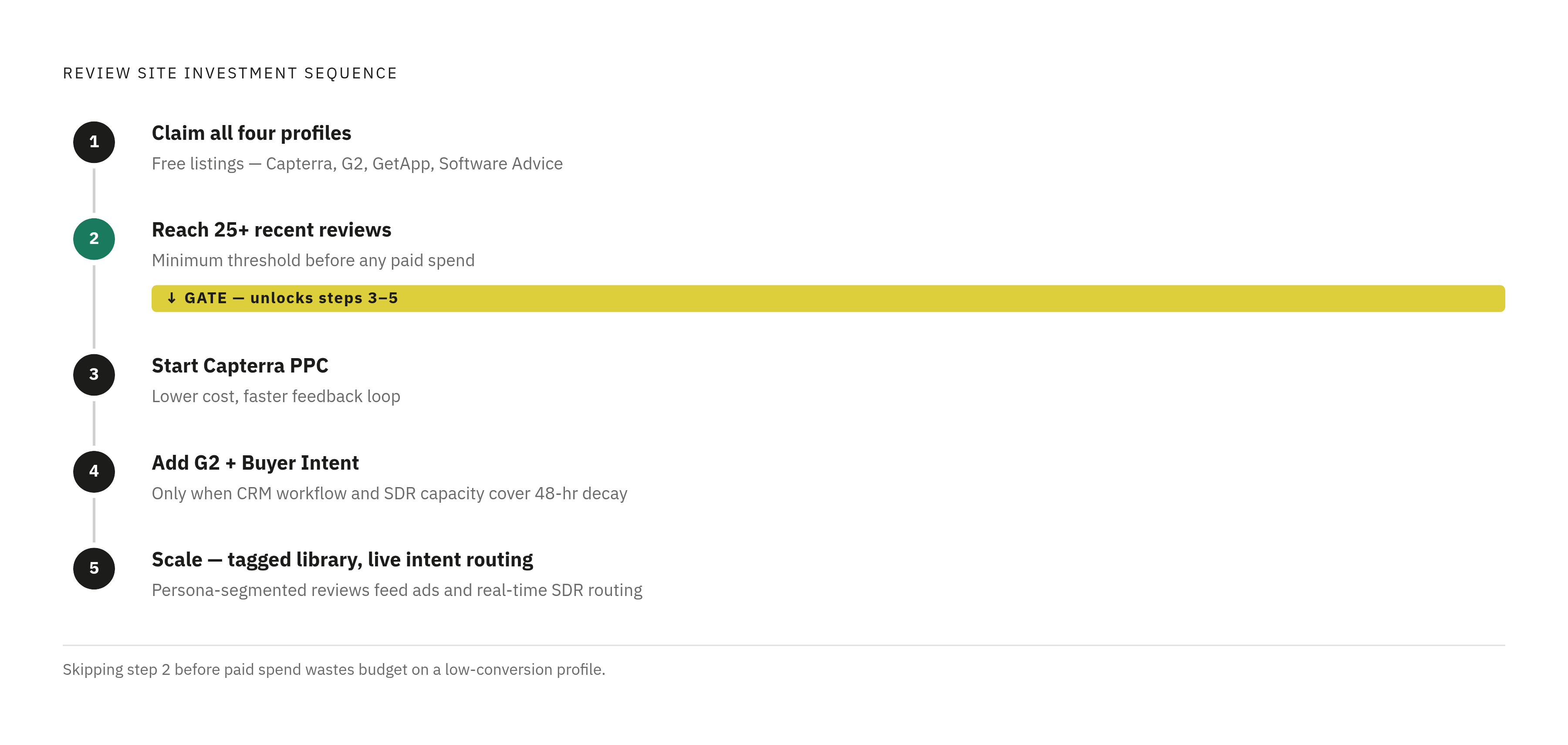
Claim and complete free profiles on all four sites, filling every section and matching category tags to the terms buyers use. Free profiles support review collection, Capterra network PPC, and initial AI search citations. Profiles with missing details weaken both organic placement and the quality of citations.
Next, build to 25 or more recent reviews before activating paid spend. Use the onboarding, renewal, and support triggers. Give newly created or sparsely populated categories attention during this stage. Establishing an early position there is substantially easier than achieving Leader status in a saturated category.
Then start with Capterra PPC before committing to a G2 subscription tier. It offers lower commitment, faster conversion feedback, and cleaner attribution than an annual subscription. Allocate roughly half to three-fifths of the budget to the main category, a fifth to a quarter to adjacent-category tests, and hold the remainder for bid defense. Set the monthly cap before launch.
Add a G2 subscription and Buyer Intent when the sales-led ABM operation is ready. The CRM workflow and SDR capacity must exist to act within the 48-hour decay window. Buying the signal before that is wasted spend. Track cost per opportunity and win rate on review-site-sourced leads.
Finally, build the review library with tags for each persona before spending more on ads. Use it across deals and turn the strongest customer outcomes into more detailed proof. Route intent into the CRM in real time, and publish evidence-rich content, including AI Custom Research, for human buyers and answer engines. Each step supplies something the next one needs.