Automating Testimonial Collection in a B2B SaaS Workflow
Trigger requests when customers hit peak satisfaction instead of waiting for someone to remember.
Most B2B SaaS teams don't have a testimonial problem because customers refuse to give them. They have one because manual collection adds friction at every step, and friction compounds into silence. The manual approach creates three layers of friction. First, asking is ad hoc. Requests go out when someone remembers, not when customers are most receptive. A customer success manager finishes a quarterly review and thinks, "I should ask them for a quote." That thought arrives days later, if it arrives at all. Second, responding is effortful. Customers face long forms, account creation, or unclear prompts. A customer who was happy five minutes ago now has to fill out a multi-page survey to say so. Third, producing is bottlenecked. A willing customer's quote sits in an email thread until someone formats and publishes it. That someone usually has more pressing work.
The result is predictable. Testimonial volume stays low. What exists goes stale. The sales team goes without proof, or it uses the same two quotes across every deal. A rep trying to close a healthcare account sends a testimonial from a fintech customer because that's all they have. The buyer notices. Trust doesn't build.
This isn't a motivation problem. It's a design problem. And it's fixable.
What makes a customer moment the right trigger for a testimonial request
The quality of a testimonial is mostly determined by when the request fires. The best responses come when satisfaction peaks, not on a schedule. Timing governs quality for a simple reason. Customers are most willing and most specific when the positive experience is recent and vivid. A request sent weeks after a milestone asks the customer to reconstruct an emotion they've moved past. They can't. The quote comes back generic: "Great product, helpful team." That's not proof. That's a shrug. Authentic, specific feedback, the kind that converts, is a perishable resource tied to a moment.
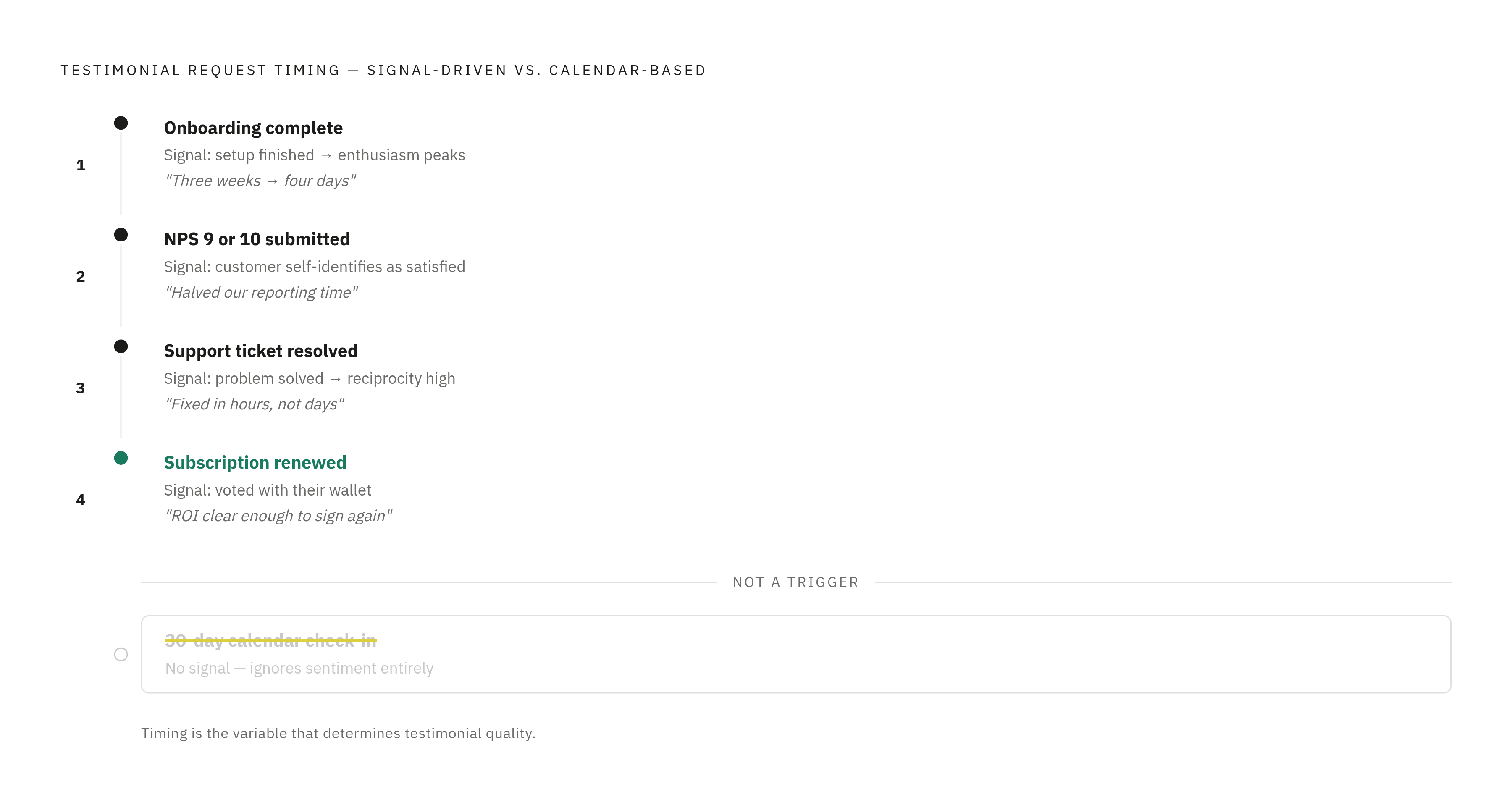
Four moments in the customer journey are trigger-worthy. Onboarding completion is one. The customer has seen the product work, and enthusiasm is high before daily-use routine dulls it. High NPS score submission is another. The customer has already self-identified as satisfied, so the ask is a natural next step rather than a cold request. Positive support ticket resolution creates a moment of relief and goodwill. The team just helped them, so reciprocity is strong. Subscription renewal is an intentional commitment signal. The customer just voted with their wallet.
These moments share something. The customer has just experienced a discrete outcome they can describe, not a vague sense of satisfaction but a specific before-and-after they can put into words. They can say, "We cut onboarding time from three weeks to four days." They can't say that three months later.
One category doesn't belong on this list: a fixed calendar date. A "30-day check-in email to all accounts" ignores whether a positive signal has actually occurred. You're asking a customer who might be struggling, right after they logged a support complaint, why they love you. That's not just ineffective. It's awkward for everyone.
How to wire CRM events to automated testimonial requests
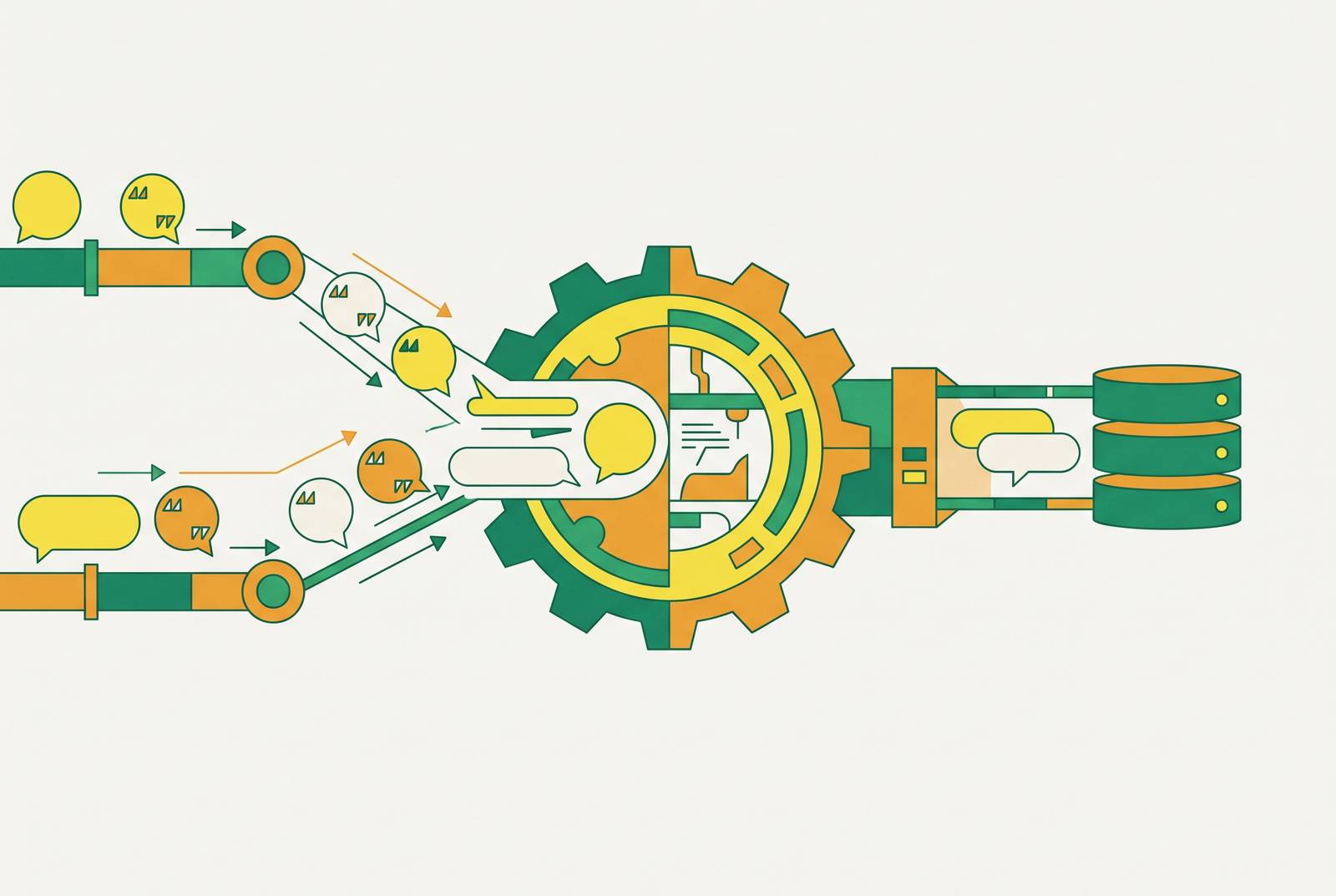
The trigger-to-request pipeline is a CRM automation problem. The right customer signal fires a workflow that routes the request without human intervention. The architecture has five steps. A customer event is logged in the CRM, something like an NPS score submitted, a support ticket closed as resolved, or a contract renewed. The event meets a condition. The score is 9 or 10, the ticket status is "resolved with positive sentiment," the renewal is confirmed. A webhook or native automation fires an outbound request: email, SMS, or in-app prompt depending on the channel the customer uses. The request links to a low-friction collection experience. No account creation, no lengthy form, no download. The submission is logged back into the CRM or a connected testimonial management tool.
Here's the NPS tier in practice. A customer submits a score of 9 or 10. A webhook fires through a tool like Zapier. It triggers an automated email with a one-click recording link. The customer records a short branded testimonial with no scheduling and no production crew. Total human involvement stays near zero until a usable asset exists. Vainu integrated this kind of system with HubSpot to automate feedback collection and generate ongoing social proof. Their VP of Marketing framed the goal as establishing trust with website visitors.
Scores below the threshold go somewhere else. Route them to customer success for a follow-up conversation, not to a public review platform. Automation that pushes dissatisfied customers to public profiles damages the advocate relationship. You'd be asking someone who just told you they're unhappy to go tell the internet about it.
Cadence guardrails prevent burnout. The first ask fires promptly after a positive signal. A single gentle reminder goes out at day 7 if there's no response. A final nudge at day 14, then stop. Anyone who declines exits the sequence and shouldn't be re-entered for the same ask. Persistence and nagging are different things, and customers can tell.
How to reduce friction in the collection experience itself
A well-timed request still fails if the collection experience asks too much of the customer. Friction at the response step is where most automated systems lose testimonials they should have captured. Think about what the customer encounters. They click a link. Then the page asks them to create an account. Most close the tab right there. A multi-page form with open-ended questions and no guidance produces the same result. Video tools that require an app download or desktop-only access eliminate the mobile user. Unbranded collection pages feel like a third-party tool, not the vendor, so the customer wonders if the request is even legitimate.
Low-friction collection looks different. The customer reaches a branded collection page in one click from the email. A single conversational prompt greets them: "What did you achieve that you couldn't do before?" Not a blank box staring back at them. The option to respond as text or video, from any device, without creating an account. QR codes as an alternative entry point for customers reached in person, at events, or during a call.
Text and video both serve the system, but for different uses. Text testimonials are fast to collect, easy to publish at volume, and fit well in landing page widgets and sales emails. Video testimonials carry higher trust and emotional resonance. Video testimonials can increase purchase intent by over 80%, and they're especially valuable for high-ticket deals where one authentic recording can carry a late-stage conversation. The practical answer for most B2B SaaS teams is to support both formats from the same collection flow and let the customer choose. Some people want to type. Some want to talk. Either way, you get proof.
Review-site routing extends the collection moment. Review balancing means directing specific customer segments to specific platforms like G2, Gartner Peer Insights, Capterra, or AppExchange based on business priority. The same happy customer who just gave you a video can also leave a review where buyers are searching. One moment, multiple channels.
Tools that support trigger-based testimonial collection in a SaaS stack
The right collection tool is the one that fits how your triggers fire, how your customers respond, and how your team publishes proof. It's a fit problem, not a best-in-class problem. Evaluate a few things before picking. Does it integrate with the CRM or automation layer where your triggers live? Does it support both text and video collection from a single branded page? Can it route customers to external review platforms as well as capturing proprietary testimonials? Does it give you embeddable widgets that update automatically as new submissions arrive? Does it support tagging and filtering so testimonials can be organized by use case, persona, or deal stage?
Senja is strong for SaaS onboarding-moment collection. It supports text and video, allows import of social proof from external sources, and organizes testimonials by tag for segmented display. So a trial user sees one set of proof and an enterprise visitor sees another. Setup has low developer dependency. It's better suited to teams wanting social proof live quickly than teams needing deep enterprise workflow logic.
For teams evaluating multiple options, the consistent differentiators across the SaaS-focused category are branded collection pages, CRM and helpdesk and product analytics integrations, moderation and approval workflows, and embeddable display widgets. Weight those over feature count. A tool with 87 features you don't use is worse than a tool with five you need daily.
Collection is the input, not the output. These tools capture the raw material: a quote, a video clip, a satisfaction signal. Turning that into a structured, deal-closing case study is a separate production step that requires a different workflow. That's the gap most teams don't notice until a rep is stuck reusing a quote from a customer who churned six months ago.
Turning collected testimonials into structured proof assets sales teams can deploy
A testimonial sitting in a dashboard is inert. The system only closes when that raw customer voice becomes a structured asset a sales rep can deploy at the right deal stage without friction. Most teams treat collection as the finish line. But the asset the buyer actually needs, a case study, a one-pager, a vertical-specific proof block, requires a structuring step between raw submission and sales use. The structure that converts in B2B has three beats: problem, solution, outcome. Buyers evaluating multiple vendors can't hold a longer narrative in working memory and won't try. Compress, don't elaborate. A customer's rambling 20-minute story becomes a three-beat proof that takes 90 seconds to read.
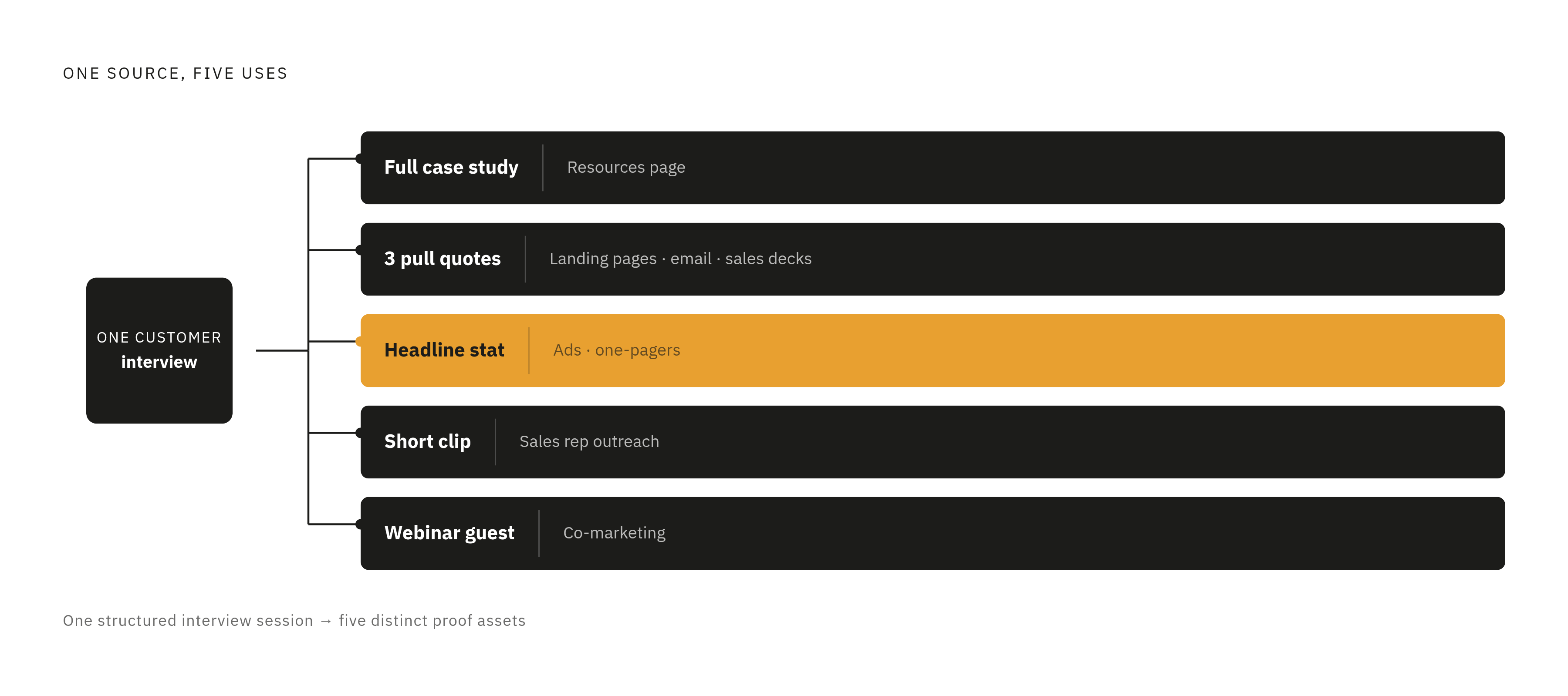
One customer interview or video submission becomes multiple assets. A full case study, problem to solution to result, for the resources page. Three pull quotes for landing pages, email nurture, and sales decks. A headline stat or outcome for ads and one-pagers. A short clip or transcript excerpt for sales rep outreach. A webinar guest or co-marketing opportunity if the customer is willing. One source, five uses. That's how the math works in your favor.
AI-assisted drafting reduces the production bottleneck. Transcription tools process the raw interview. A language model drafts the case study against a Challenge-Solution-Result framework. Human involvement drops to review and approval rather than blank-page writing. The bottleneck shifts from "who has time to write this" to "who can approve this in ten minutes."
Distribution is where most programs underperform. A case study on a resources page reaches a fraction of the pipeline it would through email nurture sequences segmented by industry, individual rep links deployed at the right deal stage, and social distribution targeting the industries featured in the story. Gong's customer story index applies outcome-first framing at scale. Bold, specific results are the entry point, not buried inside the narrative. That structural decision makes proof legible to a buyer scanning, not just one reading carefully. Salesforce organizes its case study library by industry and topic rather than as a flat list. A buyer in healthcare or financial services can filter to peers. The same proof assets become more useful without producing more of them. The minimum viable proof stack for an early-stage team: one ROI story, one technical validation, one peer quote. Organized by the deal stages where each one actually gets used, not as a library that exists for its own sake.
A system that continuously triggers, collects, structures, and distributes proof turns every satisfied customer into a standing sales asset. Not a one-time campaign. The customer who renews this quarter is generating proof for a deal that closes next year. The pipeline feeds itself. That's the whole point.