Partner Channel Proof Strategy for SaaS Platform Recommendations
Build proof around the partner's role, not just the platform.

A partner channel proof strategy for SaaS platform recommendations must validate the partner’s endorsement. That means organizing customer stories around the buyer’s segment, the problem being solved, and the partner’s contribution. The goal is proof a partner can use in a real deal and a buyer can defend within their company, rather than another handsome PDF enjoying a quiet retirement.
Why partner proof fails when it's built for the platform instead of the partner
A recommending partner puts their reputation into the conversation before a case study ever enters it. The buyer hears the story through that partner’s voice and judges it against the advice being offered. The buyer needs to know whether someone in a similar situation, working with a similar partner, achieved a result worth taking to the CFO. A story that establishes only that the platform is good leaves the partner’s recommendation unsupported.
Most platform-led case studies start from the wrong end. They show that the product works, often through an impressive customer or a broad account of business value. But a homepage success story may say little about the implementation, configuration, or ongoing service the partner is selling. The platform gets the spotlight while the partner becomes stage furniture. That is a poor fit when the buyer is considering the combined offer.
Partners cannot find stories that match what they sell, whom they sell to, or how they contribute, so they fall back on their own anecdotes. Those anecdotes may suit the conversation better, but they are not the documented evidence the library was supposed to provide. The flaw is structural. Proof that makes the platform impressive and the partner interchangeable can weaken the very endorsement it is meant to support.
What makes proof deployable in a partner's hands
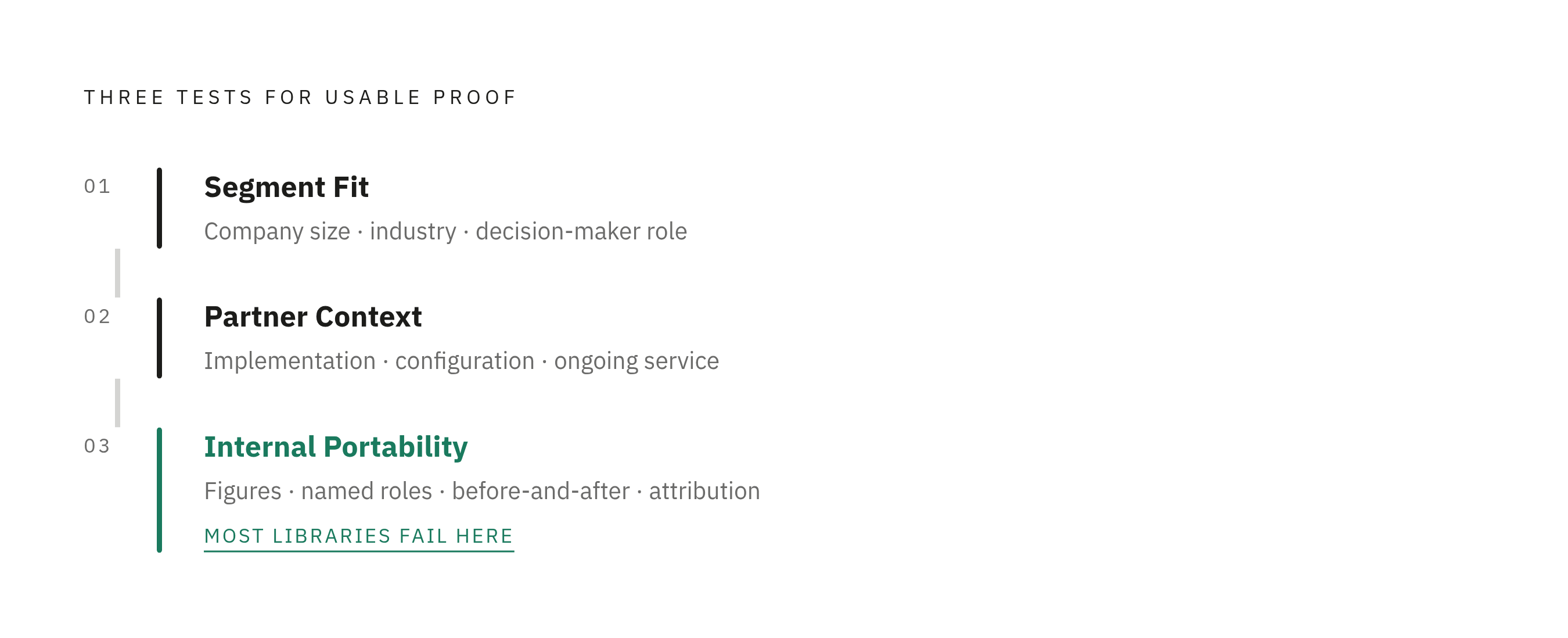
Deployable proof passes three practical tests, which are segment fit, partner context, and internal portability. Segment fit starts with the company’s size, its industry, and the role of the person who makes the decision. A large enterprise story does not establish relevance for a mid-market buyer just because both would use the same product. The buyer needs to recognize their own situation. Without that recognition, the partner must spend the conversation explaining away differences instead of building confidence in the recommendation.
Partner context makes the full offer visible. A useful story says whether a partner handled implementation, configuration, or ongoing service, so the buyer knows how the result came about. That distinction validates more than the software. It gives the buyer a reason to believe the recommended combination of platform and partner can address their problem. A story about product performance alone cannot do that job when the endorsement also includes the partner’s work.
Internal portability is the test that follows the call. Can the buyer forward the story to a CFO, print it for a steering committee, or attach it to a business case without supplying the missing explanation? The evidence needs specific figures, named roles, and a clear before-and-after account. It also needs a named, consenting person behind the result and an explanation of how it was achieved. Anonymous stories can still be useful when they contain verifiable detail, but this partner strategy requires named attribution because another business’s reputation is attached to the claim. “Improved efficiency” is a pleasant sentiment with little force as a budget argument.
Organizing the proof library around segment, use case, and partner context
Those tests work for a large library when its stories are indexed by customer segment, use case, and partner context. Customer segment includes industry, company size, and buyer persona, which is the role that owns the decision. These are retrieval fields. A healthcare prospect needs a healthcare story, and a finance prospect needs proof from a setting they know. Segment tags also expose missing coverage, so a manufacturing partner finding no relevant story reveals a sourcing gap.
Use case describes the problem solved. Buyers recognize their problem before they recognize the solution. A title such as “how a mid-market lender cut underwriting time” gives a partner a clearer route to relevant evidence than a title built around the platform’s name. The same logic supports specialists. An implementation partner focused on onboarding efficiency needs onboarding stories.
Partner context adds the dimension many libraries leave out. It records whether the story involves a reseller, implementation partner, referral partner, or integration partner, and what that partner actually did. Imagine a referral partner in fintech looking for a fraud-detection story from a growth-stage company. The intersection narrows the search to a relevant recommendation. For an implementation story, details about configuration, training, or ongoing support would establish a different contribution. Every story therefore needs role, industry, company size, outcome type, and partner involvement tagged at intake. The search interface cannot find context that nobody recorded.
Sourcing stories at the moment and from the partners most likely to produce them
The best sourcing window opens shortly after the first documented outcome. Customer enthusiasm is fresh, and the earlier situation is still clear enough to describe and quantify. A sourcing process tied to that moment captures evidence while the people involved can still explain what changed. It also avoids making story collection a separate hunt long after the customer journey has moved on.
Partners are close to the milestones where that evidence appears. Their involvement in implementation, go-live, and the first QBR puts them in a useful position to flag a result. A simple handoff lets them help without having to produce the story. That handoff can be a short partner-facing form or a scheduled post-go-live check-in capturing the customer’s outcome, willingness to be quoted, and basic tagging information. The milestone is a chance to ask, but whether there is a story depends on the documented outcome.
Selection should follow the library’s gaps. A strong candidate has a measurable result, is willing to be named, and represents a segment the library does not yet cover well. Another story in a segment that already has plenty may help less than the first story an active partner can use with their buyers. Partners who have already used proof to close a deal are especially valuable sources because they understand its practical benefit. They have a reason to flag the next result. Their role is to identify the evidence and make the handoff, leaving interviews and production to the next step.
Producing case studies that hold up under a buyer's internal scrutiny
The people a buyer shares a story with need to understand it without hearing the sales conversation. The minimum structure is the customer’s earlier situation, the solution deployed, and the resulting change. The opening establishes the role, company type, and specific problem, while the solution explains the partner’s involvement. The result then supplies a quantified before-and-after outcome, a timeline, and a named source.
“Saved time” leaves a CFO with the obvious questions of how much, over what period, and through what change. Specificity makes the claim usable. A named person, their title, their company type, and their account of the mechanism give the buyer something traceable. General satisfaction may reassure, but it cannot replace an explanation of how the outcome followed from the work.
Format determines how that evidence travels. A one-page PDF works well when following up on a proposal or sharing within a company, while crawlable HTML on the platform’s site helps people find the story through search and AI retrieval. Video can build emotional trust, especially when a partner embeds it in a proposal or sales page. Written case studies are still easier to produce in large numbers, get to rank in search, and pass along to the people who make the decision within a company. AI-assisted production can cut the time people spend drafting by using a recorded customer interview in a Challenge-Solution-Result framework. That framework should constrain the draft to the interview’s evidence.
Distributing proof so partners surface the right story at the right deal stage
Distribution starts with what a partner needs on Tuesday afternoon before a Thursday call. They need to find a story that matches the prospect and select a format suited to the decision ahead. A searchable, tagged interface supports that task. A folder of PDFs makes them open documents and reconstruct the taxonomy in their head, which is an ambitious use of Tuesday. Filters for industry, company size, use case, and partner context should make retrieval possible in under a minute, including during a live conversation.
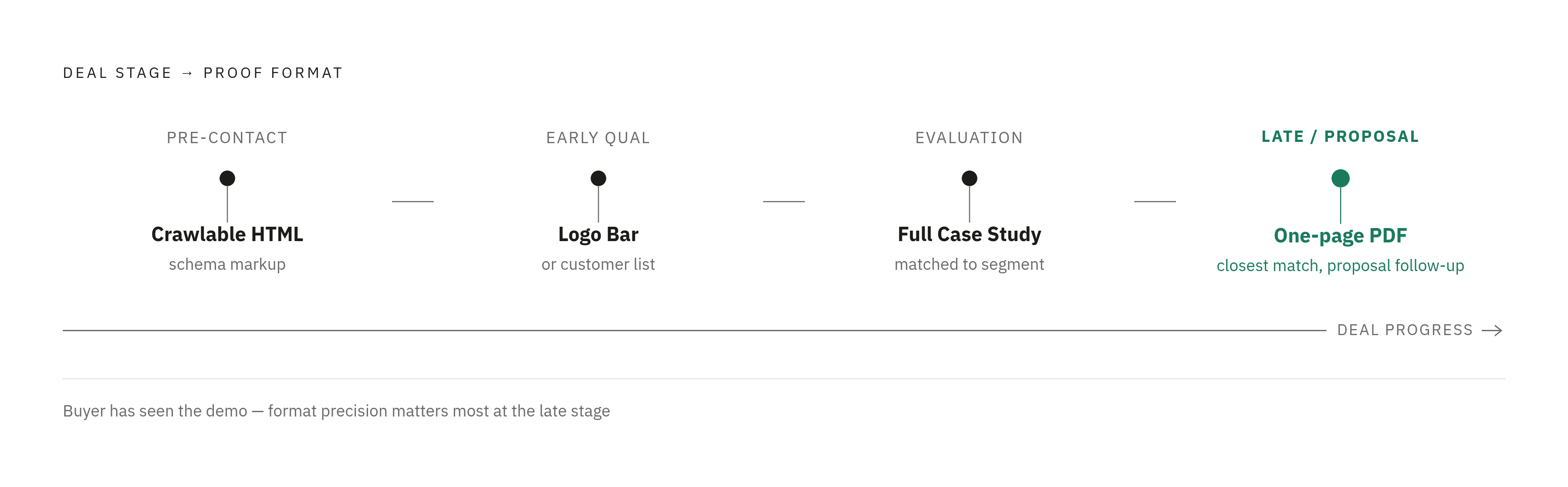
The right format depends on the deal stage. In early qualification, a logo bar or brief customer list by segment establishes that similar companies have made the choice. During evaluation, a full case study matched to the buyer’s segment and use case supplies the detail that can go to a CFO or steering committee. Late in the deal, the closest matching one-page PDF belongs in the proposal follow-up. At that point, the buyer has seen the demo and needs support for the internal decision.
A brief enablement guide can map those stages to proof types so partners know what to pull and when. This connects access to actual use. The tags added at intake let partners search, and the guide explains how the story they find fits the conversation. Crawlable HTML with schema markup also gives the same evidence a second route to buyers through search engines and AI systems. Unlike proof confined to PDFs or JavaScript carousels, that format makes stories indexable and citable during research before a buyer contacts a partner.
Building the ongoing engine through systematic sourcing
The library becomes more useful when sourcing runs continuously through the partner customer journey rather than restarting whenever sales asks for a story. Each new case study can fill a segment gap and make matching more precise. Better matches give partners more reasons to use the library. What partners report about using the stories then helps show which missing stories to seek in the next sourcing cycle. The return comes from that loop.
Several stories in a segment also help a prospect see how consistent the results are. One strong result can still look exceptional. A set of relevant stories gives the buyer a pattern to examine. A simple quarterly review keeps that pattern useful by checking segment coverage, gaps, and stories aging out of relevance. This provides a governance rhythm without requiring a large ongoing production investment. Partners who flag post-go-live outcomes have a direct stake in the quality of the result because better proof can help close their deals faster.
For an early-stage platform, this does not require a complete library at launch. One well-structured story per active partner segment provides a starting point, with rigorous metadata established before volume arrives. Case study software built for B2B sales teams can systematize intake, structuring, and tagging so customer conversations become deployable evidence without weeks of manual extraction. The software helps with the process while leaving the decision about what needs proof to people. That decision stays anchored in the partner’s recommendation and the buyer it must withstand. A continuously running engine strengthens the partner’s credibility because each cycle makes the next endorsement easier to substantiate, instead of merely giving the platform another occasion to applaud itself.