Customer Testimonial Template That Gets Specific Answers
Four interview prompts turn vague praise into proof buyers trust.

A customer testimonial template succeeds or fails on its questions. Prompts about the customer’s before-state, a concrete change, and a buying doubt resolved produce proof a skeptical buyer can use. A prettier form asking for “a few kind words” produces a prettier container for fluff.
Why most testimonials fail to close deals even when customers are happy
Teams chase customers, send reminders, collect approvals, and publish “great service, highly recommend.” All that effort buys remarkably little persuasion. The reader still does not know what problem the service solved, what changed, or whether the customer’s situation was like their own.
The customer is not necessarily being unhelpful. Ask for “a testimonial” and politeness is a reasonable response, because the request sounds like an invitation to say something nice. Asking about a real decision or a change in daily work, however, gives the customer something concrete to describe.
“Excellent experience, the team was wonderful” leaves the buying decision untouched, while a story about a slow handoff that stopped stalling between departments gives the reader an operational change to assess. Generic praise is too broad, flattering, and detached from context to reduce uncertainty. A testimonial has a job beyond looking pleased to be there.
What a testimonial that actually converts has to contain
A useful testimonial needs three ingredients, namely a recognizable before-state, one specific thing that changed, and a signal about who it applies to. The before-state shows what to compare the result with. “We were spending on ads with no way to trace a booking” describes a situation another buyer can recognize. “We needed help with marketing” barely identifies the department.
The result should then name an observable difference. A task that stopped happening, a duration, or a workflow step removed gives the reader more to assess than “everything improved.” Compare saying that work became more efficient with explaining that account managers stopped rebuilding the monthly report by hand, leaving the meeting free to discuss the numbers. An exact number is useful only when the customer can support it.
A quote about a given role, team, or situation helps the right buyer see themselves in the story, especially when it also says who would not benefit. That specificity needs an accountable speaker. A full name, job title, and company, ideally supported by a headshot or logo, make the opinion easier to trust. Identity supports the three-part story rather than replacing it with a smiling face and a title.
The five wording patterns that produce specific, usable quotes by format
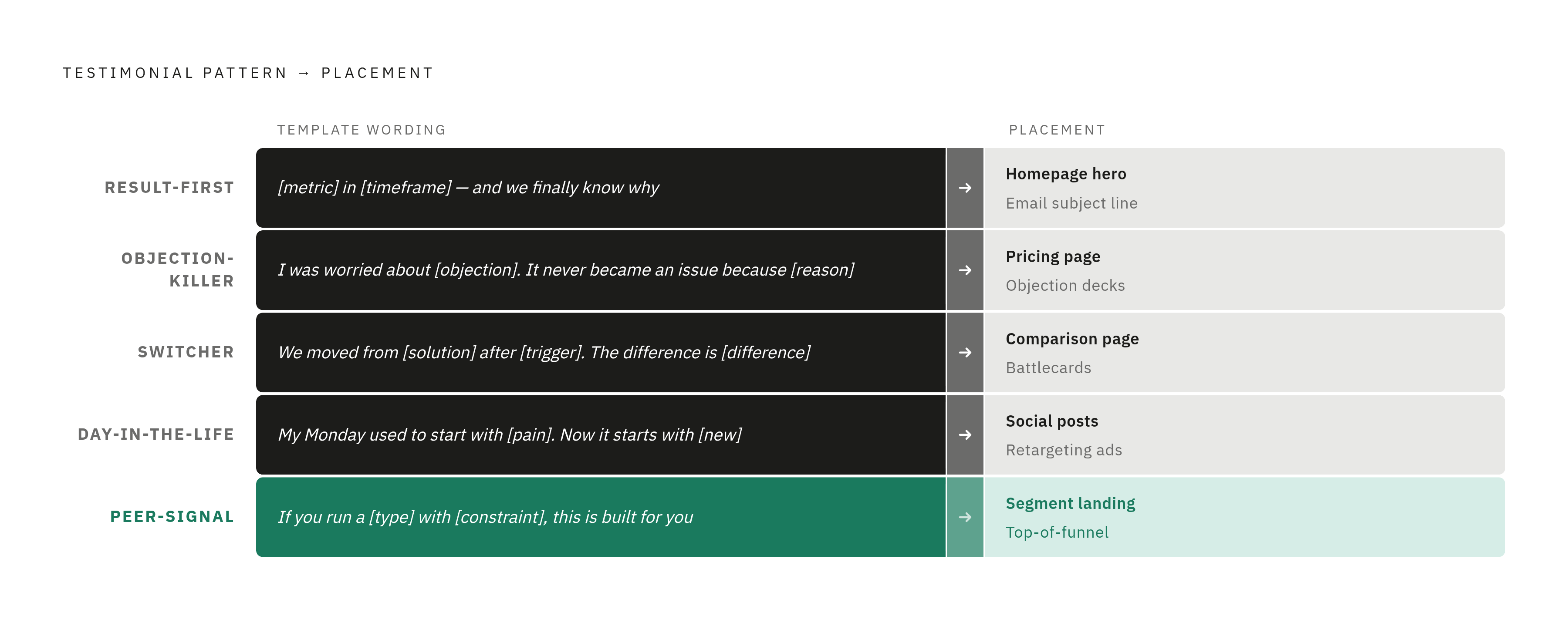
Format follows objection. A homepage needs a quick outcome, a pricing page needs reassurance, and a comparison page needs a meaningful difference. Five wording patterns offer a practical reference set for those jobs.
The result-first pattern is “[metric moved] in [timeframe] — and we finally know why.” It starts with the result a buyer wants and works well in a homepage hero or the subject line of a sales email. The objection-killer pattern instead opens with hesitation. “I was worried about [objection]. It never became an issue because [reason].” That structure belongs on pricing pages and in objection-handling decks, where an unresolved concern can hold up the decision.
The switcher pattern makes the alternative explicit. “We moved from [previous solution] after [trigger]. The difference is [difference].” It gives comparison pages and battlecards a reason for the move. The day-in-the-life pattern shows what changed in the customer’s day-to-day work. “My Monday used to start with [painful task]. Now it starts with [new task].” That contrast suits social posts and retargeting ads because the reader can picture it.
The peer-signal pattern makes recognition do the work. “If you run a [business type] with [constraint], this is built for you.” It works well on landing pages for specific segments and in top-of-funnel content. Beneath these variations sits PSR, or Problem-Solution-Results, which connects the original problem, the help provided, and the outcome before naming the buyer who would benefit. For agencies and done-for-you services, a specific behaviour strengthens that backbone. “They sent the first draft two days early” gives “they were professional” something solid to stand on.
The question architecture that engineers specificity into every answer
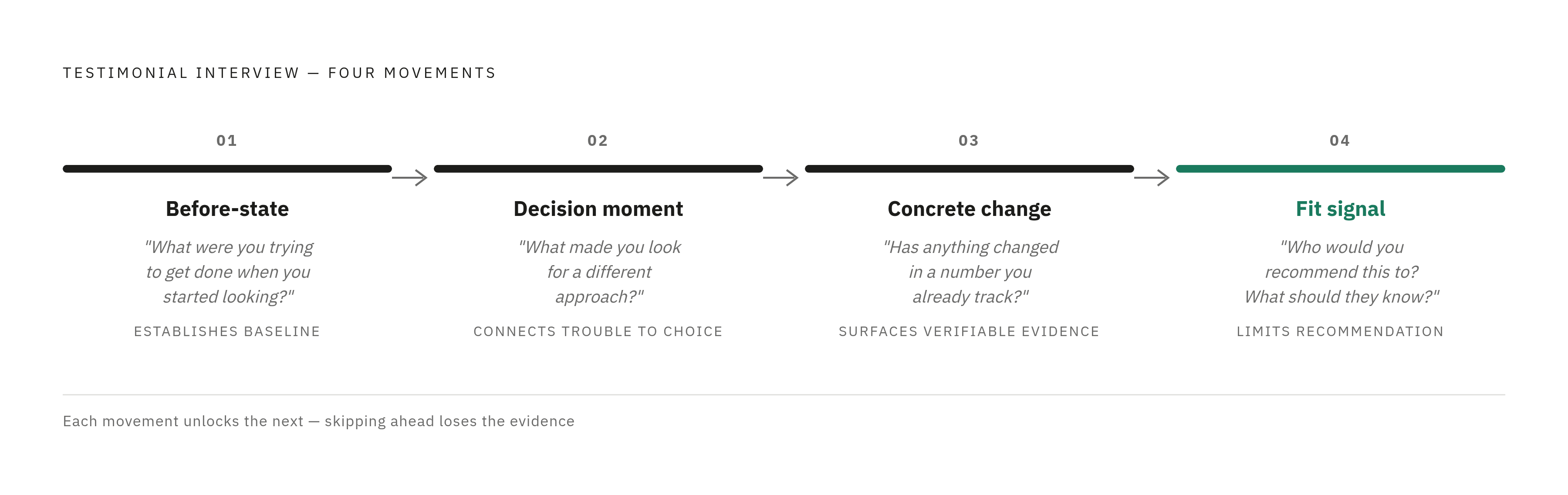
To get evidence that fits those patterns, build the interview around four movements, namely before-state, decision moment, concrete change, and fit signal. Each opens the next part of the story. The before-state establishes the work, the decision explains the choice, the change supplies the evidence, and the fit signal limits the recommendation.
“What were you trying to get done when you started looking for a solution?” gives the customer a purpose to describe in their own terms. Follow with “How did you handle that before?” to uncover the workaround, older tool, or manual step. Those answers give the reader a baseline to compare the later result with.
“What was the hardest part of that approach?” asks for a troublesome task or moment. If the answer remains broad, ask “Can you remember a specific time when that problem got in the way?” A particular occasion gives the story edges. It also supplies the detail that a polished but empty phrase such as “operational challenges” conveniently hides.
The decision movement connects that trouble to a choice. “What happened that made you look for a different approach?” can reveal a new project, a missed deadline, or a process that no longer fit. Then ask “What gave you pause before you decided?” Following it with “What helped you feel ready to try it?” reveals how the customer assessed the risk, giving a future buyer more than a claim that everything turned out nicely.
Only then move to the concrete change. “What changed in the way you do that work?” keeps the result connected to the baseline. “What can you do now that was difficult before?” can turn “more efficient” into a task the team can actually complete.
Numbers need a separate test of support. “Has anything changed in a number you already track?” invites evidence from the customer’s existing work. Ask which metric changed, what period it covers, and where the figure comes from. If the customer cannot verify it, leave the number out. A specific qualitative result is better than arithmetic wearing a false moustache.
Finish by asking where the experience applies. “Who would you recommend this to, and what would make it a good fit for them?” asks for a role, team, or situation to narrow a recommendation of “everyone. Follow with “What should someone know before they start?” to make room for a limitation or condition. That limit makes the advice easier to trust because it sounds like something a colleague might say and makes clear which buyers it fits.
Follow-up prompts that rescue a vague answer after it has been given
Even well-built questions can produce a vague first answer. Treat that answer as a starting point to work into proof. When the customer says “it was great” or “it really helped,” ask “What happened that made you feel that way?” The follow-up accepts the impression while asking for the event behind it. There is no need to put a happy customer in the witness box.
After “we saved a lot of time,” ask “Which task took less time, and how did you notice?” If the answer introduces an unsupported number, ask “Where does that figure come from, and what period does it cover?” These follow-ups, including using the qualitative version if the customer cannot check a number, are easier in an interview than a written form, particularly when the answer needs nuance. A voice interview gives the customer room to explain without requiring a camera or polished prose.
How to make the ask easy enough that customers actually say yes
To turn the question set into completed testimonials, remove friction from the request itself. Offer the format that takes the least effort for that customer. A written form can be quick, video captures a face and tone, and voice allows a fuller answer without filming.
Explain what the customer receives as well as what they contribute. A professionally written case study or testimonial can become a document they share with their own stakeholders. Offer privacy choices before they have to ask. Full attribution, company-only attribution, or aggregate framing can suit what each customer feels safe sharing, though readers have less to go on when they know less about who is speaking. That trade-off is better handled openly than discovered at approval.
Before publication, send the exact quote and attribution for approval, confirm where it may appear, and keep a record of permission. Approval is not the only publication requirement. The FTC requires adequate support that advertised testimonial results are typical or a clear and conspicuous disclosure of the generally expected performance in the circumstances shown. It also requires disclosure of any material connection. Those obligations belong in the publishing process before the quote is live.
Turning one customer interview into a proof system across multiple sales contexts
A well-structured interview produces source material for several sales contexts. The account of changed work can become a short product-page testimonial, while the original hesitation and its resolution can support a pricing-page objection-handler. The fit answer can supply a peer-signal snippet for a comparison page or battlecard. A day-in-the-life contrast can work as a social post. All these pieces come from the same conversation, so the customer only has to tell the story once.
The longer story answers a different question. A case study can show whether a team like the reader’s could use the solution successfully from start to finish. It has room for the original problem, what had already been tried, the solution, and the resulting change. Measurable results, attribution, and verifiable proof assets support that account where available. The extra space is best used for details of how the work changed, with praise kept brief.
Those details are especially useful to sales teams working on deals. Each proof point should go where the doubt it answers comes up, so the rep has evidence that fits the buyer’s situation and stage. This can be handled internally or through a service. Verbatim, a done-for-you case study service for B2B companies, builds customer stories around the same before-state, specific change, and fit structure.
With the right questions built into each interview, new customer stories add specific, deal-relevant evidence to a growing library. Reps then have material to draw from without commissioning a fresh story for every deal.