Customer Story and Case Study Management Platforms for B2B Marketing Teams
Pick a platform by where your proof stalls, not by feature lists.
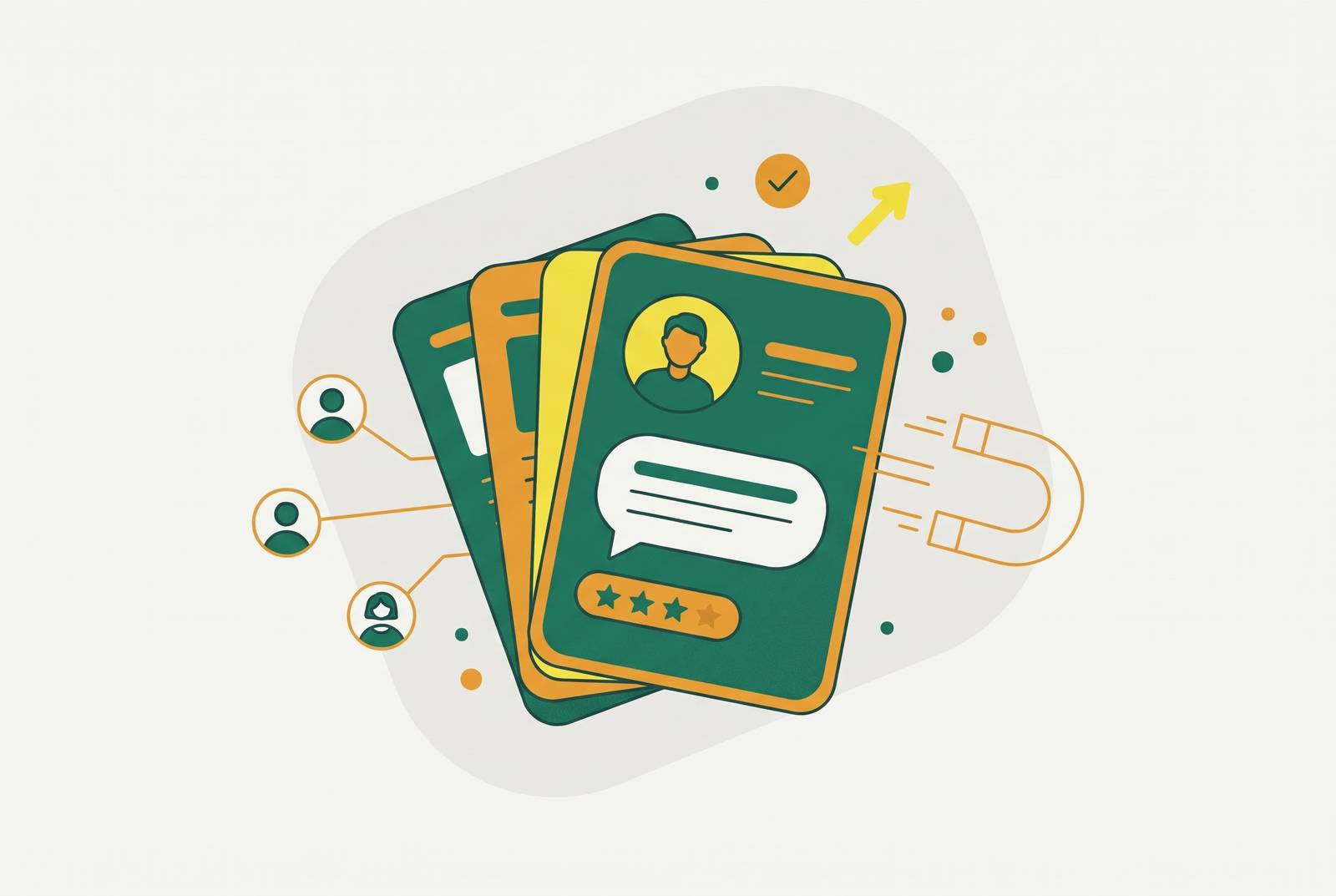
Customer story and case study management platforms solve different problems, even though they turn up on the same search-results page. For B2B marketing teams, the right choice starts with finding where proof gets stuck, then buying help for that job. A platform that displays a story cannot replace one that gets the story out of the customer.
Why teams comparing case study platforms often solve the wrong problem
The comparison tab is open, and the shortlist includes a deck builder, a testimonial widget, a video platform, and a writing agency. All promise customer proof. Yet their demos answer different questions, so comparing their features is about as useful as comparing a microphone with a filing cabinet. Both belong somewhere in the process. Neither can do the other’s job.
The confusion starts with the search itself. “Case study software” can mean presentation tools, collection widgets, video platforms, agencies, enterprise survey platforms, or tools that interview customers and write stories. Each handles a different part of production, so a team can choose a good product and still leave its actual problem untouched.
Who gets the story out of the customer? If the answer is the marketing team, the software starts after that work is done. That may be exactly right for a team with interview capacity, but not for one struggling to get a credible, specific, approved story in the first place.
What makes customer proof valuable enough to build a system around
Customer proof matters because AI-generated content cannot take the place of a real, named customer who describes a specific result. AI search engines also show third-party reviews, quoted testimonials, and cited case studies when people look into vendors. A proof library therefore shapes how a company appears in zero-click B2B research and what visitors read on its website.
But the evidence is easy to dilute. Account managers may know what changed, while marketing gets a polished account that leaves out the numbers and detail that made it convincing. Proof buried in Slack or customer conversations is equally vulnerable when an executive needs an ROI story or a late-stage buyer wants evidence from their industry. “Customers love it” is not much help in a budget meeting.
Strong libraries keep that value by making proof specific, relevant, easy to find, and available in a choice of formats. They surface quantified outcomes before a visitor opens the full story and offer meaningful search and filtering. The production system needs to preserve the evidence, then make it usable when a buyer needs it.
The four jobs a case study platform can be built to do
Story production turns evidence from customers into a written or video story that people can trust and that has been approved. It serves teams that need help with interviews, before-and-after metrics, drafting, and sign-off. Some providers own the interview, while others assume it has already happened. That distinction defines how much work stays with marketing.
Proof collection gathers testimonials, quotes, survey results, and short clips across a broad customer base. It serves teams that need coverage. It assumes lightweight responses are enough for the intended use. A flagship story remains a separate production job.
Presentation and distribution put proof that has been approved into decks, microsites, digital rooms, or embeddable walls. They serve teams whose evidence exists but is difficult to find, share, or use. The story is already approved in this model. These tools get it into a deal.
Advocate management tracks customer participation, reference requests, permissions, and overuse. It helps teams that work with customers on several kinds of proof. It assumes there is enough going on to need a system just to track it. A team can need help with any one of these jobs without needing another platform for the other three.
Platforms built for story production: who runs the interview and writes the story
Production options differ chiefly in how much work they remove and which formats they deliver. The first decision is about interview capacity. A team that can run customer conversations may only need drafting and approval support, while a team without that capacity needs a provider that owns the interview too.
Uplift Content is a B2B SaaS writing agency covering case studies, white papers, ebooks, and blog posts. It offers custom retainers, month-to-month, with no long-term contract required. That works for teams that want one writing team to handle case studies and other long-form content. The scope extends beyond customer stories alone.
MarketScale coordinates interview scheduling, structure, and logistics, then captures customers on camera through a global network of professional videographers, on-site or remotely. It provides the work as video, written content, and sales assets. Pricing is set through a discovery conversation. The Customer Story focuses on unscripted customer testimonial films, including remote stories and cutdowns for ads, social, and sales, with custom pricing per project.
Agency production has a practical trade-off. Timelines can run several weeks from customer introduction to final draft, while the price per story limits most teams to a handful each year. That can work better for a few flagship stories than for stories that cover a wide range of customers.
StoryVoice takes a different approach to the interview. Customers speak to a voice AI interviewer for roughly five minutes on their phone, without a camera or booked call. It writes the case study, extracts the headline result, and produces a pull quote, LinkedIn post, X post, and sales email. Customers use a link to check the story before it is published, and metric cards link to the exact sentence it came from.
The AI-interviewer model offers lower cost per story and faster turnaround, with roughly two minutes of team time to create and share the interview link. StoryVoice is free to try, with no credit card required. It is text only by design. A video requirement rules it out, regardless of how convenient the interview looks.
For teams seeking done-for-you written production, Verbatim is a content studio for early-stage B2B teams that handles the customer interview, drafting, and approval. It is an option when the team needs someone else to extract the story, rather than another tool to use after the conversation.
Platforms built for proof collection at scale
Proof collection works when a team needs evidence from many customer segments without a deep story for each customer. G2 reviews, NPS comments, testimonials, and short video clips can provide that breadth quickly and cheaply. Volume has a legitimate purpose here. The mistake is treating collection as a substitute for narrative production, or paying for full production when lightweight proof would do.
Probing a vague answer for the before-and-after metric or turning a short response into a developed narrative requires editorial work beyond collection. A customer who submits “great product, easy to use” has supplied a testimonial. The widget is not hiding a follow-up question behind the curtain.
For teams with many happy customers, collection can fill gaps while the money for production goes toward flagship stories for late-stage deals. Anonymous but verified proof also addresses a distinct constraint in cybersecurity, financial services, and healthcare, where named stories may be off the table. In those settings, teams need to establish what evidence customers can provide.
Platforms built for presentation, distribution, and sales enablement
Excellent stories can still fail commercially if reps cannot find or deploy them. When locating relevant proof takes too long, the familiar three-year-old case study wins by default. That calls for better systems. More production can simply add more files to the same difficult folder.
For teams evaluating this category, the practical test is where approved proof needs to go. Storydoc handles presentation once the team has the story, after the interview and approval work. It works for teams that already have proof, especially when they need it in an interactive format. It does not remove the need to produce the evidence.
Digital rooms and interactive decks give reps a URL with their branding that they can track and that buyers can share within their company. Segmented microsites can serve a particular industry or explain why customers switched from a competitor. Integration with Highspot, Seismic, or Slack puts proof where reps already work. A separate portal is one more place they have to remember to visit.
Format also needs to match the deal. A long-form story serves a technical evaluator, while a one-page summary travels in a champion’s internal email. A 90-second video clip works well in a follow-up sequence. Platforms therefore need to deliver usable proof at the right moment.
Platforms built for advocate management and reference programs
Advocate management helps when teams ask the same customers for reference calls and story production. A reference request, speaking slot, case study, and logo approval may each seem like a small ask on its own. Together, they create a relationship cost. Without tracking those requests, teams may see how much they have asked for only when a customer says no.
SlapFive tracks advocates, automates reference requests and referrals, and supports surveys, stories, and testimonials. It also offers case study writing as a service. With its pricing unpublished and prospective buyers directed to contact it for a demo, that mix works for teams that manage how customers take part as well as produce proof.
Most early-stage teams do not need this layer first. A lightweight CRM tag or spreadsheet can be sufficient until activity makes dedicated tracking necessary. For teams reaching that point, the evaluation should cover approvals, usage rights, and advocate usage by channel. The software earns its cost when overuse risk becomes measurable.
How to identify where your production bottleneck actually lives
Where does the story get stuck? If customers will not agree or scheduling drags on, the problem is outreach and coordination, which an agency or AI interviewer can help reduce. If conversations happen but never become stories, the missing capacity is drafting. If drafts wait on customer or legal sign-off, approval status and permissions need attention.
Approved stories that reps ignore point elsewhere. In that case, the team may need distribution, findability, sales enablement integration, or a microsite layer. A production upgrade will not necessarily fix that blockage.
What work can the team handle now? A team able to run 30-minute interviews but unable to write should choose a tool that drafts from transcripts. A team without interview capacity needs a tool or agency that runs the conversation. Volume changes the choice too, because one or two flagship stories a year is a different assignment from covering eight product lines and four industry segments.
What does a rep in an active deal need this week? A request for fintech proof calls for the right industry and company size. A CFO asking to see ROI needs a one-page summary with a hard number. These questions can expose a coverage or format gap.
The clearest wrong-category signal is an empty queue. The team bought a formatting or distribution tool and still does not have enough approved stories to put through it.
What a proof program looks like when the platform matches the bottleneck
A well-matched production system lets one customer story support several buying moments. A structured interview can feed a long-form narrative, a one-page sales summary, a pull quote, and, where video is captured, a clip. Each asset has a distinct use. Production economics improve when those outputs share the same evidence and extraction work.
As the library grows, stories across the industries, company sizes, use cases, and buying personas the team sells into are more useful than a larger collection concentrated in one segment. Permissions must keep pace with that growth. Customer quote and logo approvals can take anywhere from one day to over a month, so untracked approval work can leave useful proof unavailable.
The commercial test comes after publication. Page views and the number of stories cannot show whether proof helped a buyer move forward. A defensible program connects its library to specific deal velocity, win rate by segment, or pipeline sourced. Those are the outcomes that justify protecting and growing the budget, rather than funding a better-organized collection of PDFs.