Asking Customers for G2 Reviews
Pick the right customer, time, and channel so reviews actually publish.

Getting G2 reviews that publish takes more than a well-worded email. It takes the right customer, a recent experience they can describe, and a trusted channel that gets them through verification. Make review requests part of the customer lifecycle.
Why G2 review volume matters more now than it did a year ago
More buyers now find, research, and weigh their options before they speak to a sales rep. By the time a demo is booked, opinions are already forming. Review sites now help shape software shortlists, while AI systems draw heavily on review content when summarizing categories. A G2 profile is therefore a live commercial asset.
But a large review count is not enough. G2 applies “Grid Decay,” an exponential decay function compounded daily, so a review from well over a year ago has a fraction of a recent review’s weight. A steady flow of reviews is therefore more useful than bursts now and then, even when those bursts make the profile look healthy for a while.
Why most review asks fail before they reach the customer
The person, the request, the moment, and the route to publication are mismatched. You have probably used at least one familiar shortcut, such as asking the fastest-responding contact or sending a launch-day blast. Those choices fit the vendor’s schedule but do nothing to help the customer write a review that buyers can trust. A small-deployment contact may respond quickly but leave buyers with the impression that small deployments are the product’s main use case.
G2’s Fall 2026 Trust & Safety Index says identity issues make up its largest fake-review category. Customers who use personal Gmail addresses must provide a product screenshot or risk failing identity verification, which makes the process harder than it needs to be with a work email or LinkedIn account. None of this requires a more persuasive subject line. The fix starts with selecting people who can describe real use, then giving them a clear path to submit it.
Which customers to ask, matched to what they can credibly say
Start with eligibility, then match the person to the experience. G2’s community guidelines allow reviews from actual users, business partners, and guest users who used the product within the last two years. Employees of the vendor or a direct competitor are barred. Partner and guest reviews are labeled and do not count toward the G2 Score. An enthusiastic contact is not automatically the right reviewer.
Within an eligible account, different people hold different evidence. A day-to-day user can describe workflow speed and usability, while an admin can explain rollout, configuration, and support. For example, a user who has just completed a previously impossible workflow could get the ask this month. The admin at the same account could get it next quarter, once adoption has stabilized. An economic buyer is better asked during QBR or renewal prep, when the conversation already covers results that can be measured.
The selection should reflect the market you want to attract without filtering for praise. Seek a mix of roles, company sizes, and use cases so buyers can find someone like them. Defer requests during an open support escalation. That is a service decision, and reviewers must remain eligible regardless of likely criticism or NPS score.
When to send the ask: the moments that produce specific, publishable reviews
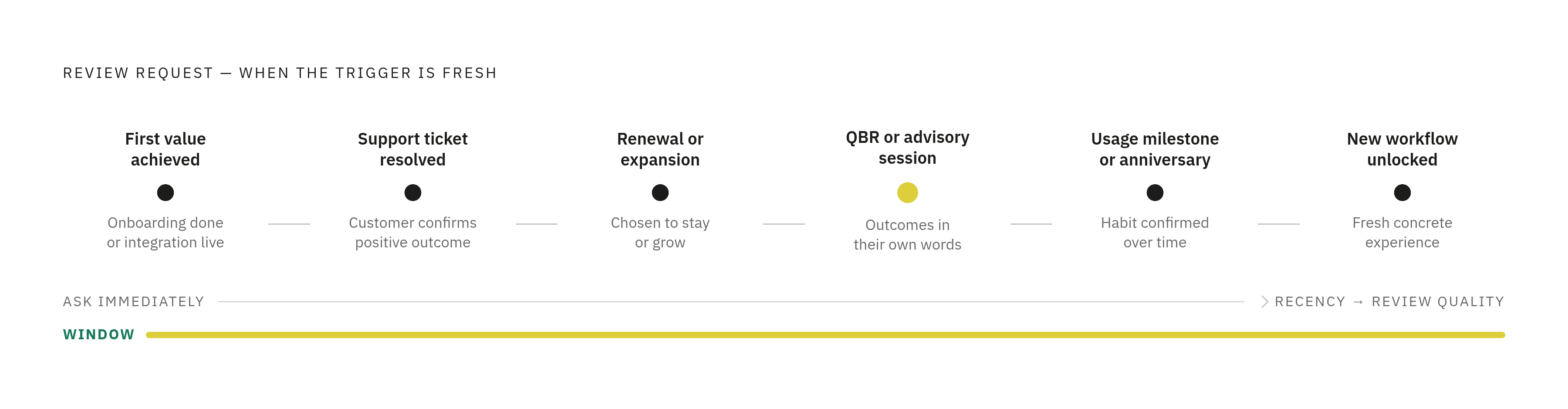
Once the right person is clear, timing determines how much they can say. Ask within a day of a sign that things went well, while the experience is still fresh. A customer who just named an outcome has language available that may disappear into a vague recollection months later. Specificity has a short commute from experience to review. The longer the delay, the more likely a useful account of what changed becomes a generic compliment.
For a SaaS customer, first value might mean onboarding is complete, the first report has been sent, or an integration is working. Renewal and expansion offer another opening because the customer has just chosen to stay or grow. A resolved support ticket can also be a suitable moment once the customer has confirmed the resolution and rated it positively. The unresolved ticket is not that moment. Asking for a review while someone is still waiting for help confuses a service queue with an advocacy program.
QBRs and customer advisory sessions are especially useful when customers explain outcomes in their own words. Meaningful usage milestones, anniversaries, and newly possible workflows can provide similar openings. Use those events to time the request rather than asking the customer to reconstruct a whole relationship from memory. Something that happened recently gives them a concrete experience to describe, which helps buyers judge whether the product could work for them.
How to structure the ask itself: message, channel, and sequence
The message should name the experience, explain what is being asked, and make the review easy to submit. State that the review takes only a few minutes, then link directly to the G2 review form. Do not send customers on a profile-finding expedition. Invite honest feedback, positive or negative, and disclose any incentive without making it depend on the rating. The customer should understand the request without translating marketing copy.
A CS manager’s note after a first successful workflow could read like this.
“You’ve just completed your first workflow with the product. Would you share that experience in a G2 review? It takes only a few minutes, and honest feedback, positive or negative, helps other buyers understand what to expect. You can use the direct G2 review form linked here.”
The route should feel as familiar as the message. Start with a personal note from the customer success manager or account owner who knows the customer. Broader cohort emails can work, but they still need a reference to the customer’s experience. G2 advises against sharing review links publicly, so keep them in direct email, closed channels, private groups, or partner and affiliate channels to limit access by non-customers.
Anyone who declines or signals dissatisfaction should move into a separate customer success loop. A repeatable process should know when to stop asking as well as when to start.
G2's compliance rules and what breaks them in practice
G2 prohibits positive-only targeting, including methods that segment out potentially negative reviewers. Detected patterns can lead to review removal across the batch. This makes sentiment-based selection more than a credibility problem. Asking only for praise can waste the work of customers whose reviews otherwise met the rules.
G2 caps incentives below a set dollar threshold, including swag, tokens, credits, and subscriptions. Positive and negative reviews must receive the same reward, or none at all. Incentivized reviews are labeled, so buyers can see the arrangement. The FTC’s rule on consumer reviews, 16 CFR 465, also prohibits incentives conditioned on a particular sentiment in the US.
AI assistance has limits, too, rather than a blanket permission or ban. G2 allows it for reviewers who are LinkedIn Verified, on a seller-provided list, or submitting in-app. It bans fabricated experiences and AI writing a review on someone else’s behalf or replicating their feedback. Unverified reviewers may still use tools such as Grammarly or Google Translate. Assistance with expression is not a substitute for the reviewer’s own experience.
Verification is the more useful place to remove friction. Encourage customers to use a work email address or LinkedIn account, since a detailed review alone does not prove who wrote it. G2 says it cannot reject a review just because it is generic. A short, honest review from a verified customer can publish, while a detailed one from an unverifiable identity may not.
Building the ask into an ongoing system rather than a recurring campaign
A monthly rhythm gives these mechanics an operational home. Track review status alongside renewal and expansion stages in Salesforce or HubSpot so the team can find customers who are ready to be advocates and avoid asking them twice. Add review asks to QBR agendas, renewal emails, and lifecycle touchpoints when customers reach a success milestone. Ownership belongs in the CS playbook. Otherwise, everyone may support the task while no one takes charge of it.
HubSpot workflows, Zapier, or Make can trigger requests from completed onboarding milestones or positively closed support tickets, send customers to a direct G2 link, and log each touch. NPS surveys can help coordinate timing, but an NPS threshold must not become a gate that excludes potential critics.
PandaDoc moved from occasional quarterly incentive campaigns to an always-on system after a pipeline-match analysis found that G2 drove outsized pipeline compared with other review platforms. The shift helped G2-influenced deals close faster and kept the number of reviews growing year after year.
memoryBlue tied requests to customer journey milestones, synchronized them with quarterly NPS surveys, and used an internal advocacy leaderboard to sustain engagement. It traced a measurable block of influenced pipeline in a single month directly to G2 activity.
What to do with reviews once they publish: feeding pipeline and finding case study candidates
Respond to every review, positive and negative, with a thoughtful public reply. A response to criticism can reassure a prospect by showing that the vendor listens and acts. Then give reps reviews that address the objections they hear in discovery. A customer’s description of a relevant experience can do work that another vendor claim cannot.
Put useful quotes on pricing and product pages, near calls to action, in nurture emails, and in proposals. Use earned G2 badges such as Leader or High Performer on the homepage and landing pages as third-party signals. Placement should serve the buyer’s question. A quote about rollout belongs where someone has questions about rollout, rather than wherever a page happens to have an empty rectangle.
Reviews with specific details and high scores also help narrow down who might be a good case study candidate. A reviewer who has described a measurable outcome has already supplied the core of a potential story. Follow up to explore the result, then develop it into a structured case study with the detail and narrative a G2 review alone cannot provide.
To understand the commercial return, track new reviews per month, average rating trend, profile visits, and pipeline from review-site referrals. Combine click tracking with self-reported attribution, since buyers may credit review sites for influence that never appears as a referral click. That gives the team a broader view than review count alone. Reviews feed pipeline, which helps the team find advocates whose stories become case studies that help close deals. The cycle repeats without asking the team to start from zero each time.