Sales Leave-Behind Documents for In-Person B2B Meetings
A good leave-behind lets your contact sell the deal without you.
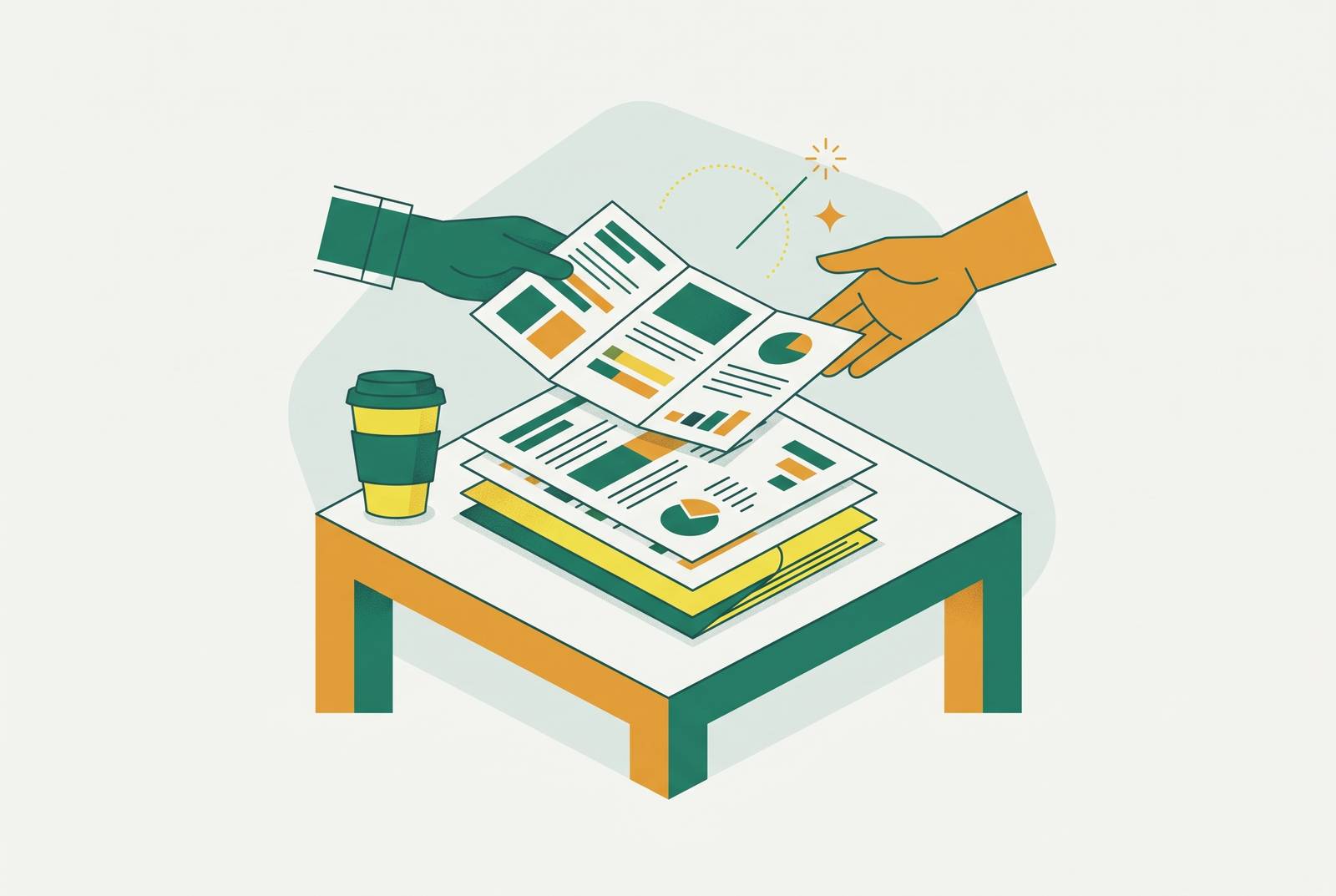
A sales leave-behind for an in-person B2B meeting has one job, which is to persuade without you there. The best documents help your contact explain the offer, defend the evidence, and justify the expense to colleagues who never attended. That calls for a small, purposeful kit that readers can understand on their own.
Why the leave-behind exists: the room you never get into
The meeting went well, and then everything went quiet. It is tempting to replay the conversation for mistakes. But the weak point may be what you handed over. The person you impressed now has to explain the offer to people who have never met you. Somewhere between that good conversation and a decision, your contact must make an argument they may not feel equipped to defend.
That is the room the leave-behind must enter. It gets there through an email, a chat message, or a laptop opened while someone says, “this is the one I mentioned”. Your delivery and helpful explanations do not travel with it. Gena Dakos, formerly a Global Sales Enablement Program Manager at Stripe, offers the useful test of whether a document can stand alone without your voiceover. If you need to attach a note explaining what the attachment means, the document is not finished.
Why most firms default to the wrong document and what it costs them
The capabilities overview is a natural default because its ingredients are already available. Services, company background, credentials, and logos are easy to gather. Buyer uncertainty is harder to package neatly. The buying group wants to know whether this is worth doing, what it costs, what happens if it goes wrong, and who owns it. A document built around who you are leaves those questions largely untouched.
A capabilities deck is often written to be presented, so the presenter supplies the connections between the company’s strengths and the buyer’s problem. Once forwarded, it loses that connective tissue. A champion who cannot reconstruct the argument has little they can confidently defend.
CSO Insights found that reps originate roughly a fifth of the content they use. When the material they have misses the buyer’s question, sellers make their own, often at the last minute. In a small firm, that seller may also be the owner and the entire marketing department. Rewriting the same explanation for each prospect consumes time without creating a reusable answer. If the capabilities overview cannot do the job, what should replace it?
The four documents a deal actually needs and what each one is for
A deal needs four documents that each answer a different question. The RECAP framework names the coverage they need, including Results, Evidence, Credentials, Action, and Pricing clarity. These are five jobs within the kit. Results need evidence to back them up, credentials show the firm is qualified, and action gives the buyer a next step. Pricing clarity keeps the prospect from seeing a blank, thinking “expensive,” and guessing a price that is higher still.
The one-pager answers what this is, who it is for, and roughly what it costs. Use the buyer’s language to explain the offer, its distinguishing features, and how to get in touch. Keep it skimmable enough to rescue an imperfect memory. Its reader may be someone who half-remembers the meeting or a finance director who never attended. Under the Dakos test, both should be able to explain the offer correctly without calling you to make sense of it.
The proof story answers whether this has worked for someone like the buyer. It needs one relevant company, its situation, what was done, and what changed, compressed into a paragraph or two. A logo wall cannot answer that question. Logos show that a firm has customers, while a story about one gives the champion something to compare with the buyer’s own case. A longer case study can support it, but the leave-behind needs a summary that can travel with a single sentence of introduction.
The written scope answers what the buyer would actually be buying. A mini slide deck or proposal summary can explain the offering, approach, and pricing in terms a skeptical colleague can picture. Ambiguity can look remarkably like a price objection. Someone who cannot picture the work may stall to avoid admitting confusion in a meeting. A clear scope gives that person something they can weigh up.
The money case answers whether the expense can be justified internally. It is a business case for the champion to take to finance. Use a modest number that can withstand questions. Include a price anchor that gives a starting point. Without one, the prospect has to invent a number, and that guess is likely to be higher than reality.
How the physical container shapes what a buyer does with the contents
The folder holds the useful parts and is the first physical expression of how you operate. It influences whether those parts get picked up again. Consider Dana’s leave-behind, a slim branded folder with a one-page case study and a handwritten sticky note on the inside cover. The note thanked the operations director by name for a specific point he raised. That detail connected the package to the conversation rather than making it look like something distributed by the handful.
Put the Results or proof page where the prospect sees it first. Place the action-facing page in the right-hand pocket, facing up, and put a business card in the card slot. These placements use the existing four-document kit.
Keep the production choices simple and consistent. Brand colors, logo, fonts, good paper or print finish, and a clear visual hierarchy are enough to make the contents feel deliberate. A stapled stack of photocopies suggests a different operating model. Even sound evidence has to survive long enough to be read, and a package that looks assembled five minutes before the meeting starts at a disadvantage.
Building the proof story that survives scrutiny from people who weren't there
The proof story needs more care because its reader may doubt it from the start. Start with a customer who mirrors the target buyer’s industry, company size, and recognizable challenge. Relevance gives the skeptic a reason to read. A strong result from an unfamiliar setting may still leave the central question unanswered. The story’s job is to make the comparison credible.
Build that comparison with five elements, starting with situation and stakes. Situation replaces vague descriptions such as “a mid-size manufacturer” with the client, sector, scale, and starting condition. Stakes explain what was at risk in concrete terms. Describe the pain concretely. These elements let readers judge whether the customer’s problem is like their own before they are asked to admire how it turned out.
The solution then explains what was actually done, the timeline, and the key decisions. Outcomes show what changed through quantified, verifiable results and enough method for finance to defend the number. Stakeholder voice rounds out the story with the customer’s own words. Keep the human edges in those quotes. Awkward phrasing or mild criticism can make the account more believable than a polished endorsement that sounds as though it has passed through six departments and lost its pulse.
For deployment, turn the full story into a digestible one-pager and a presentation slide. The champion needs a short version to forward, with the fuller account available for scrutiny. One customer interview can also supply a written case study, a two-minute video testimonial, a ten-slide deck reference, a blog post, and social quotes. The same evidence can go out in all these forms without the work starting from scratch each time.
Turning proof collection into a system instead of a favor you ask once
A strong case study is useful, but it is not a proof collection system. Teams that repeatedly call on the same two or three customers create a fragile dependency. Those customers get called on whenever someone asks for a reference or a new chance to make a sale comes up. Eventually, advocacy becomes an unpaid second job. Advocate burnout can harm the relationship before the team sees how few customers it has left to call on for references.
Collect evidence continuously. Surveys after the sale, quotes from call recordings, and third-party reviews can help the library grow. Track advocate usage and score burnout risk so the pool expands before relationships degrade. A formal customer story program gives that work a cadence. Approach customers a few months after implementation, offer public recognition and co-marketing exposure, and put each new story into the library immediately.
One case study cannot speak to buyers in every industry, company size, and role. Coverage requires both volume and variety, with customer conversations turned into structured case studies. The payoff appears in the next meeting. A team that keeps its proof library up to date can pick a story that fits the prospect instead of handing everyone the same familiar customer’s greatest hits.
When to hand over print, when to send digital, and how to make both survive the buying process
Print and digital serve different legs of the journey. Print suits in-person meetings and trade shows because it gives the buyer something tangible to keep and revisit. A folder can sit on a desk and get picked up again, as Dana’s package was designed to do. Digital PDFs work well for email follow-ups, hybrid meetings, and material shared before or after webinars. When possible, prepare both versions, with branding and layout suited to each format.
Trackable delivery can show opens, clicks, and video plays, giving the rep evidence of engagement and potential circulation beyond the first contact while leaving the purchase decision unconfirmed. Digital also supports a living asset, with updates, hyperlinks, and interactive features as the deal develops. Print fixes a version in place, even if the scope has changed before the fifth stakeholder reads it.
A QR code can connect the printed kit to a digital portfolio, calendar, or full case study. It gives the physical document a trackable digital tail. The destination still has to earn the reader’s attention and make sense without an explanation. Apply the Dakos test to both versions, including the one opened by someone outside the original conversation.
Matching the leave-behind to the moment in the deal
Document selection depends on the question the buying group is asking now. At an intro call or first discovery meeting, the one-pager and a single proof story give the champion enough to explain the offer and establish relevance. Anything much heavier can misread the buyer’s stage. A money case that fits month nine may just get in the way in month one. Completeness across the deal does not require handing over the entire kit at every meeting.
After a demo and before a formal proposal, the written scope becomes more important because the buyer needs to picture the purchase. At proposal review, especially when finance joins, the money case moves to the front. The proof story remains available as support. Credentials may need more emphasis in a proposal environment, but they still serve the buyer’s decision. The four documents change position as the questions change.
In-person meetings need extra care because they should settle things that matter to the deal, such as scope, price, or a champion’s commitment. The on-site score weighs six considerations, including deal size, stakeholders absent from video calls, a workflow to observe, proximity to a decision, a deal going quiet, and a customer invitation. Four or more yeses means go. The leave-behind for that visit should reflect what the room needs to decide.
The habit to build is mapping the document to the current buying question after every in-person meeting. If it answers a different question, good writing will not rescue the mismatch. A maintained proof library makes that habit easier by putting relevant stories within reach before each visit. The meeting may end at the door, but the buying conversation does not. Your documents need to be ready for their part in it.